Back to the States

The temperatures in Paris France were dropping fast. Even with gloves on, my sketches were getting a bit shaky.  I had to leave my hotel near the Eiffel Tower very early to meet my Uber driver for a ride to the airport. I had success navigating Paris with the Metro and considered taking it to the airport, but the maps were not super clear on which stop I needed at the end of the line. I also was concerned about possible wait times as I switched trains at several stations. I’m glad I took Uber because it gave me a chance to look at the landscape as we drove out of the city.

I was rather sad to leave Europe because I knew I would be returning to strip malls and a fascist government. I documented an World War from 80 years ago but war was most certainly likely to break out again. The American president considered himself a war time president during the worst of the pandemic. He will only truly feel masculine when he is using the military against Americans and against nations of his choosing.

I thought I was documenting the worst possible fascist regime by sketching WWII sites my father passed through and liberated in Germany, but Germany learned its lessons from America which has always been racist and had no problem putting Japanese Americans in concentration camps at the start of WWII. Germans put people who were not Aryan enough into concentration camps. America is now following suit by randomly picking up people off the streets who do not look American enough. Children are being used as  bait to seize and imprison parents in the detention centers.

It started to snow as we drove towards the Charles de Gaulle Airport. It was the first now I had seen in my three months sketching the movements through Europe of the 75th Infantry Division. I am sure my father, 1st Lieutenant Arthur Thorspecken had visited Paris on leave from Camp Cleveland which he helped run. My father left Europe on about August 1, 1945, on a boat to America. He had been in Europe for 1 year, 3 months and 18 days. I originally wanted to stay in Europe sketching for the same duration, but the Schengen rule only allowed me 3 months to complete my sketch project. I had to rush through the 70 or so cities in France, Belgium, Netherlands and Germany at a much faster pace with my tiny French rental car.

You can tell a lot about a country by how people drive. Driving in Paris was of course hectic, but country driving was a delight. Belgium and the Netherlands both felt relaxed. Trucks drove below the speed limit, and all the other drivers were very polite. When I drove the speed limit, I would always find myself passing most of the traffic. Germany on the other hand is much like America in that all the drivers seem to be in a furious rush to get to the next stop light. Germans tail gate even closer than Americans do. They would rather drive though you than around. I had no desire to have a German officer stop me for driving too fast so I stuck to the speed limit. I started singing a little jingle every time there was a German on my butt. Every German I met who saw my rental car always commented on the French license plate. It looks just like a German license plate but with a tiny F instead of a tiny G. It might have been a mistake to drive the whole trip in a French car.

I also have a baseball cap that has the American 75th Infantry logo on it. In France people love the Americans for their help liberating their country from German occupation. The cap helped me fit in with WWII reenactors and others who appreciate the accomplishments of the greatest generation during WWII. People in Belgium and the Netherlands also appreciated seeing the emblem from 80 years ago. When I crossed the Rhine River into Germany, I stopped wearing the 75th Infantry Division hat, replacing it with a simple black cap.

At the time of my flight back to America the government had been shut down and air traffic controllers were not being paid. I was almost certain that flight would be delayed. I had no choice, my 3 months in Europe were up. Other than the exhausting wait going through customs the flights ran on schedule. All 6 of the sketchbooks I had filled were in my backpack along with multiple books about Stalag VI-A the POW camp that the 75th Infantry Division helped liberate. I am still translating the German book about Stalag VI-A too learn all about the camp which would have opened my father’s eyes to the horrors of how people are treated as subhuman and starved to death for the sake of a fascist Aryan ideal. I have no doubt that what he witnessed would have molded his world view for the rest of his life. If he were still alive, I would have so many questions.

March 28, 1945: Hessian State Theater, Wiesbaden Germany

After sketching in Plettenburg Germany, I arranged to visit distant Thorspecken cousins in Wiesbaden Germany. Back in 1994 I visited all of the Thorspecken relatives I could find based on researching my family tree. One relative was a professional flute player for the state theater in Weisbaden. When I interviewed her back in 1994, she was nursing her newborn baby girl. That child was just married, and she helped me on this project by agreeing to allow me to ship the empty sketchbooks to her home in Koblinz Germany. When my first sketchbook was completely full, I drove to Koblinz to pick up the other 6 sketchbooks and was treated to a delicious traditional German breakfast in their home..

We all agreed to meet at Hessan State Theater in Wiesbaden. This is where my cousin performed fin the orchestra for so many years. She retired recently from performing in the theater, but she knows every nook and cranny of the place. One entrance of the theater was for the king and all his horses. She showed me the kings box seating which was of course the best seat in the house.

I loved when we explored the prop rooms and the huge scenic shop. Large scenic drops were on the floor being painted. Another theater had a rehearsal going on but my cousin marched in with confidence, and we watched for a while from the back rows. Another rehearsal was going on in a lobby which was super elegant with highly ornate gold trim. We watched that rehearsal which was in English from an upper balcony. The theater was a buzz with activity.

Wiesbaden is situated above natural hot springs. Steam can be seen rising from the ground in many spots. A fountain allowed people to sample the sulfur flavored water which is supposed to have healing properties.

My cousin used to live in Weisbaden but she just recently purchased a home out in the country. The home had a wood burning stove and a balcony that has a gorgeous view of the valley surrounded by large hills. I loved the way her home was decorated, it had an elegant old world feel. She practiced her English and I practiced my limited German. After a day of exploring Wiesbaden with my cousins, they insisted we go to a spot high on the mountain that overlooks the city to have a hot mulled wine. It was the perfect end cap to an amazing day.

Wiesbaden became a military base during WWII for the General Command of the XII Army Corps and the 3rd battalion of the 38th Infantry Regiment. It was also a target for Allied bombings because of its industrial support for the Nazi war machine. Allied bombing raids targeted Wehrmacht facilities, the Glyco-Metalworks production plant, the Dyckerhoff and sons cement works, Kalle chemical works, the Albert chemical plant among others. There were frequent attacks on both industrial and residential areas. By the end of the war, around 30% of Wiesbaden’s buildings had been destroyed.

The Hessian State Theater that we visited, had extensive damage to the north side during the Allied air raid of February 2 to 3, 1945. In that air raid, nearly 500 British aircraft dropped 1,251 tons of bombs, including several so-called blockbuster bombs, which could destroy entire city blocks. But the city was lucky — heavy cloud cover meant it was spared the destruction suffered by many German cities in the war.

Wiesbaden was liberated from Nazi control on March 28, 1945, by the U.S. 80th Infantry Division alongside elements of the 4th Armored Division during the drive to the Rhine. On that morning at 5:45 a.m., a white flag was raised on the bunker at the museum, marking a peaceful surrender despite the Nero decree which insisted on evacuation and destruction of all infrastructure. My father, 1st lieutenant Arthur Thorspecken would have been much further north, crossing the Dortmund-Ems Canal on the way to attacking Dorsten Germay. The 75th Infantry Division did not take part in the liberation of Wiesbaden.

After Wiesbaden was liberated, it became a major hub for American forces. The city served as a major U.S. Air Force base (crucial during the 1948–49 Berlin Airlift) and housed the “Central Collecting Point” for art recovered from the Nazi’s by the Monuments Men.

C-Company runs Camp Cleveland

On June 1, 1945 my father. 1st Lieutenant Arthur Thorspecken and the men of C-Company of the 1st Battalion of the 75th Infantry Division was posted to Camp Cleveland between Rhemes and Morormelon Le Grand France. The camp was a U.S. Army personnel redeployment or “staging” area for troops who were about to head back to the United States after their service in Europe. It was part of the massive logistics effort by the U.S. military to manage troop movements in the European Theater of Operations (ETO) in the final stages of the war in 1945. Some would go to the states while others might go to the pacific to fight the Japanese.

The camps near Le Havre France were named after popular brands of American Cigarettes the camps closer to Rhemes were names after American cities like Cleveland, New York City, and Boston. The camps varied widely in size, from around 2,000 in capacity to nearly 60,000 at the largest of the “Big Three”, Camps Philip Morris, Old Gold, and Lucky Strike.

Camps were referring to the camps without indication of their geographical location went a long way to ensuring that the enemy would not know precisely where they were. Anybody eavesdropping or listening to radio traffic would think that cigarettes were being discussed or the camp was stateside, especially regarding the city camps. Secondly, there was a subtle psychological reason, the premise being that troops heading into battle wouldn’t mind staying at a place where cigarettes must be plentiful and troops about to depart for combat would be somehow comforted in places with familiar names of cities back home (Camp Atlanta, Camp Baltimore, Camp New York, and Camp Pittsburgh, among others)

C-Company took care of administrative details at camp Cleveland, like pay status and they made sure every soldier had a complete uniform. Many uniforms were rags after years of battles. The administrative work was low key, and the weather was beautiful. There were frequent passes available to Rhemes and Paris. The camp had an enlisted men’s club, a Non-Com’s Club and an Officer’s Club. C-Company had a softball, volleyball and tennis team.

Many of the soldiers had enough points to go back to the states, other soldiers didn’t have enough points so they would likely be redeployed to the pacific to fight the Japanese. Hundreds of thousands of soldiers were waiting in these camps at the end of the European Theater of Operations. The soldiers would have been deployed to take part in a huge amphibious assault on Japan called Operation Downfall. When the atomic bomb was dropped on Hiroshima many of these soldiers felt relief that the war was over.

Plettenberg Germany, Böhler Cemetery

Cross shaped headstones for German soldiers were right behind me as I sketched the Böhler Church in Plettenberg Germany. It seems any time I sketch in a cemetery there is a small army of lawn mowers buzzing between the headstones or it is raining. The lawn care guy mowing near me got closer and closer. I shouted out, “Do you need me to move!” in German. He shouted back “Nein!” After he was done, he looked over my shoulder, probably to see how long I had drawn the grass. After I sketched the church, I considered leaving since it was rather cold, but I could not resist and I turned around and sketched the headstones.

In Plettenberg, the first Allied artillery shell landed just beyond the Böhler Cemetery. Between 10 and 11 a.m. that Friday, the American troops advanced again in skirmish formation, coming down Grafweg, into the Plettenberg town center.

Manfred Rettig recounted: “…My father, Walter Rettig, owned the Wilhelm Schade factory canteen during the war. In 1945, my father had to provide the mess hall for a Wehrmacht unit. Some soldiers from this unit had entrenched themselves above the former collection pond at the Schade company. There was a tank barrier in the valley. As far as I know, these soldiers were killed by the Americans. We children, (about 10 years old) could still see the blood in the ditch for a long time afterward. A few days after the war ended, a friend of mine was killed by a rifle grenade that was found…”

There are over 50 soldiers’ graves in the Böhler cemetery, including 9 graves of Hitler Youth who died during clean-up work in Dortmund Germany. According to a census from January 1951, there are 159 war graves in Plettenberg; a total of 40 foreigners (30 Russians, 2 Poles, 8 Italians) who were prisoners of war, or forced laborers in Plettenberg were buried here; during World War II, 111 German soldiers were buried in Plettenberg. The total number of victims of the Second World War can only be estimated. Estimates range up to 80 million war dead.

After the war in 1949, demolition experts were clearing ammunition near Plettenberg, when an anti aircraft shell exploded. Police Sargent Bruno, was killed and a bomb disposal expert was seriously injured. A 17 hear old farm hand who was showing them the duds, miraculously was not injured. The bomb disposal expert was quickly rushed to the hospital, and doctors tried to keep him alive.

On April 15, 1945, the 75th Infantry Division located possible camp sites for Displaced Persons, and checked road and bridge conditions in the area south of Dortmund Germany. On April 22, 1945 the 75th was given the task of placing road guides on the approach to Plettenberg. The troops then assembled in Plettenberg at 11:30am. On April 23, 1945 the first platoon including my father 1st lieutenant Arthur Thorsecken’s C-Company, set up an Observation Post (OP) on the main North West road into Plettenberg. An OP is a position used by soldiers to monitor enemy movements, warn of approach, or direct fire. On the 24th they were relived of OP duty and assigned the mission of reconnoitering in the area South of Plettenberg, Germany in the Division area to look for road blocks, road and bridge conditions, and ammunition dumps. On April 26, 1945, the 3rd and 1st platoons continued reconnaissance of area South of Plettenberg, Germany in the Division area. The 2nd platoon set up OP at the Division Headquarters in Plettenberg, Germany. The 1st platoon was alerted. On April 27th to 30th, the Division set up Ops at the Plettenberg Hospital and Radio Station.

After the German surrender on May 8, 1945, the 75th Division was tasked with securing the Westphalia region, including Iserlohn and Plettenberg. The division’s duties included managing displaced persons, securing the area, and caring for Allied prisoners of war.

Plettenberg Germany: Fish belly arch bridge

I I decided to spend several days in Plettenberg Germany which was the command post for the 75th Infantry Division at the end of WWII. I drove to the Lenne River where I parked at the AquaMagis water park and then walked to this steel beam Fish Belly Bridge built which was built in 1914. Since it was cold, the water park was quiet. It was a crisp fall afternoon and the walk along the river was gorgeous.

The Fish Belly Bridge was once used for a railroad line. It was closed in 1969 and has been designated a historic site. The  Bridge survived World War II. A walking platform was added to the former railroad bridge. From on top of the walkway, you would have a wonderful view of the Lenne Valley. I climbed up onto the bridge platform. The bridge leading to the west stopped abruptly after a few yards. A metal gate kept people from walking on this dangerous section of the bridge. The other direction over the river is still operational.

As I was sketching, a grandmother and daughter stopped to talk to me for a while in German. I know enough German for short conversations but I only understood maybe half of what the grandmother told me. She was old enough to have been alive in 1945. She wished me safe travels. The daughter knew some English since she lived in the United States for some time. Talking to them made me realize I was hungry for conversation. I had been drawing for 3 months straight every day and people often stopped and spoke to me in French, Dutch, and German. My usual response was “Thank you” in each respective language. Distractions were limited when the people vying for my attention could not be understood. I missed talking to a friend back in the states who is a consummate conversationalist.

The 75th Infantry Division occupied Plettenberg in April of 1945, and stayed for some time while doing governmental work, building up the hospitals, railroads, bridges and water pipes. As always, immediately upon arriving in Plettenberg , the Division’s units set up their Command Posts and a series of signs throughout the town indicated their locations. Each Division in the European Theater of Operations, (ETO) had a different letter with which their individual outfits’ code name began. And so the indicator for 75th Headquarters was D for Diamond.

Water points were established to supply fresh filtered water for the troops. Not only was the job of purifying water in combat important, but it was equally vital when the Division settled in towns like Plettenberg where it was necessary not only to purify water to increase the supply for the troops, but also to test the civilian supply already in operation. With men living so close to one another, the dangers involved in contracting  germs carried by water could result in catastrophe. The men of the water points were diligent, knowledgeable , and tireless.

May 8, 1945: Plettenberg Germany

Plettenberg, Germany was the last 75th Infantry Division command post in 1945 at the end of World War II. My father, 1st Lieutenant Arthur Thorspecken was leading C-Company of the 75th Infantry Division. The 75th was tasked with occupation duty in a large area around Plettenberg Germany, known as Westphalia.

On May 8, 1945 Nazi Germany signed an unconditional surrender of its armed forces to the Allied forces. The Stars and Stripes newspaper headline declared, NAZIS QUIT! Donitz Gives Order. Grand Admiral Donitz, Adolphthe successor to Adolph Hitler. Ordered the surrender. Celebrations broke out in New York City and London immediately. The 75th Infantry band marched through Plettenberg to celebrate the good news.

Relief was felt by every soldier, but the world war was still far from over. The 75th Infantry Division was engaged in routine duties of occupation in the Westphalia region of Germany. This was no easy task since they had to feed and care for 90,000 displaced persons many of them forced laborers and Prisoners of War.

Though victory in Europe was being celebrated, every soldier worried that they might be shipped off to the pacific where the war was still raging against Japan. Occupation duty meant that the soldiers were no longer being pushed from one battle front to another. The pace had slowed down and with peace in Europe men began to hope that they might get to go back home.

The military had a points system for discharging soldiers at the end of hostilities. Each soldier was granted one point for each month of service. They received 2 points for each month overseas. They would be given 5 points for each ribbon, and 5 points for each star. Soldiers with children under the age of 18 received 12 points for each child. Soldiers with 85 points qualified for immediate discharge. The demobilization system began on May 10, 1945.

So in May of 1945, Arthur Thorspecken would have built up the following points…
1 point per month in service… Arthur Thorspecken entered the service on February 4, 1943. On May 8, 1945 he would have served 2 years and 3 months. This amounted to 27 Points.
2 points for each month overseas. Arthur was overseas for 16 months. This amounted to 32 points.
5 points for each ribbon and 5 for each star. Arthur Thorspecken was awarded an American Campaign Medal, an African-Middle Eastern Campaign medal with 2 battle stars, a World War II Victory Medal, and a Combat Infantry Badge. Each medal equals a ribbon, so that amounts to 20 Points and 2 stars adds 10 points for 30 points total.

12 points for each child. Arthur Thorspecken married Elvira Corr while he was in Camp Davis in North Carolina. Elvira had her first child while he was still in infantry school. Elvira’s baby girl was born while Elvira was in Massachusetts. Arthur  did see pictures of his baby girl before being shipped overseas. That amounts to 12 points.

That would be a total of 101 points which would qualify him for immediate discharge. Arthur still served on Occupation Duty in Europe for 3 more months until his discharge could take effect.

In August of 1945, the 75th Infantry Division strength was 20,785. Of these 11,147 had less than 65 points. 7,183 had scores of 85 and higher. Arthur Thorspecken likely departed Europe on about July 29, 1945 when he would have taken the week long boat ride back to America. He was officially separated from the military on August 4, 1945 at Fort Dix, New Jersey, which was just 2 days before the United States dropped an atomic bomb on Hiroshima Japan. The idea of a world at war took a seismic shift towards peace.

April 20, 1945: Hemer Germany, War Memorial

When driving out of Hemer towards Plettenberg Germany, I noticed this World War I and II memorial dedicated to the solders from Hemer who died in the wars. I usually planned my sketch opportunities in advance by researching the night before, but in this case, I just stumbled across this memorial as I was driving. I pulled off the main road and turned around to sketch.

On April 20, 1945, 300,000 German soldiers surrendered in the Ruhr Pocket. April 21, 1945, was the end of the Ruhr offensive. After seeing Stalag VI-A in Hemer, I started to drive to Plettenberg Germany where the 75th Infantry command post was in operation at the time.

On April 25, 1945, American and Soviet forces met at the Elbe River near Torgau, Germany, a defining, symbolic moment in World War II known as “Elbe Day”. This link-up cut the German army in two, signaling the collapse of the Nazi regime and marking the effective end of the war in Europe. By April 30, 1945, Adolph Hitler had committed suicide in Berlin. The World War in Europe would officially end on May 8, 1945 when Germany surrendered. 1st Lieutenant Joe Colcord of the 75th Infantry Division wrote, “VE Day was quite a celebration as it meant that we were not going to the East to join up with the Russians at the Elba.”

After Germany’s surrender, the 75th Infantry Division became the civil-military government in Westphalia Germany, caring for 175,000 Allied prisoners of war and displaced persons which formed a central part of their duties. On VE Day the 75th Infantry Band marked through the streets.

Lieutenant Paul Cunninham of the 75th Infantry Division, wrote about his experience at a German camp for Russian POWs… “men to sick to work were sent there to recover. In reality they were sent there to starve to die, starved to death. If someone did get well, he was immediately sent to work in the mines. 25,000 men were kept where only 9,000 could be accommodated.”

My Father 1st Lieutenant Arthur Harold Thorspecken was in charge of C-Company in the 1st Battalion of the 75th Infantry Division which was part of the 290th Infantry Division. 290th Infantry Division.

A dedication was sent to all the soldiers after Germany surrendered… “ Today we have achieved final and conclusive victory over Germany. The monster that was Nazism lies crushed and broken. The road to victory has been long and bitter for everyone. It has been built by the unfaltering courage and the steadfast devotion of every man serving under the flags of the Allied nations. The darkest hours have been illuminated by the flames in the hearts of free men fighting indomitably onward to the final victory.

As we are gathered here to celebrate the great day, we must certainly be joined by the spirits of those of our comrades who have sacrificed their lives in order that we might accomplish this victory. To those men whose unselfish devotion to duty shall live forever asa torch of freedom, we most humbly dedicate this day. May God grant men the wisdom needed to carry on ideals for which they have died.

While VE Day is an occasion for thanksgiving and celebration, it comes to us with the realization that long dark months of trails and tribulations lie before us. Not only great dangers, but many more misfortunes, many shortcomings, many mistakes many disappointments will surely be our lot. Death and sorrow will be the companions of our journey, hardship our garment, and valor our shield. We must be united, we must be undaunted, we must be unyielding. Our qualities and deeds must burn and glow through the gloom of the world until they become the veritable beacon of it’s salvation.

Today concludes the first phase of our titanic struggle. A struggle which will ultimately end with our crushing defeat of the last barrier to world peace.”

After Stalag VI-A in Hemer Germany was captured by the Americans, it was renamed Camp Roosevelt. It was a long road to liberate all the POWs in the camp. Hundreds of Soviet POWs kept dying every week from the many months of starvation. Soviet prisoners sent back to Russia would be seen as traitors, so after all the horrors of capture and forced labor they would go back home to be treated with suspicion. Camp Roosevelt  was then used as a camp for detaining Nazi prisoners.

Russian Memorial Hocklingerweg Hemer, Germany

In the final months of World War II, the area around Islerohn Germany saw the surrender of German forces to the American troops. My father, 1st Lieutenant Arthur Thorspecken with his C-Company in the 75th Infantry Division, moved into Hemer to help liberate Stalag VI-A, one of Germany’s largest POW camps.

The Americans of the 75th Infantry Division distributed U.S. Military rations to the starving prisoners. Approximately 22,000 men were found at the camp with 9000 of those in the camp “hospital”. Patients suffered from Tuberculosis, Dysentery, Malnutrition, and Typhus fever. Inmates were from the Soviet Union, France, Belgium, Netherlands, Poland, Italy, Yugoslavia, Romania, Great Britain, Canada and America. American War photographer Joseph D. Karr was on the scene documenting the struggle to keep men alive. Despite being offered food rations, many men were just too far gone. Over 100 men (mostly Soviets) kept dying every day. Soviets were given half or less of the rations that other nationalities were given and over the week before liberation there was no food distributed in the camp since the cooks and guards had retreated East away from the advancing American troops.

Two cemeteries were established for the mass graves for all the men who were dying. The exact number of men who died is hard to calculate. Some researchers think 24,000 men lie in the two cemeteries. Others think that number is too high, while others think that number may be far higher, based on the rising numbers of inmates who died at the end of the war. The goal of commemorating is to never forget. Future generations need to know what man is willing to do in the name of an ideology and how quickly a society is willing to throw away basic moral principles.

Early in the war, the first men who died were buried in a forest near the Stalag. The dead were buried in simple wooden coffins. Most of these men were French (166) and Polish (42). By 1945 there were 335 graves. War graves agreements after the war, insisted that the bodies be returned to home countries. The remaining graves were then moved to the two cemeteries dedicated to the Stalag dead in Hemer.

The numbers of Soviet dead kept growing exponentially. They had been through the hell of war, capture, forced stays in the front-line Stalags followed by excruciatingly long cold train rides into the Reich where they were immediately put into forced labor details. Additional land had to be acquired from a Protestant parish for the hundreds of men who were dying each week. The bodies were carried on a horse drawn carriage on the shortest route up the hills and winding roads to the cemetery. Long excavated trenches had been dug, and the bodies were unceremoniously thrown into the pit. People walking down the street, or passing by train could see the grisly scene. There was no secrecy to the mass murder taking place.

By the end of 1943 all the rows had been filled with bodies. The capacity of the cemetery was exhausted. More than 3,500 Soviet prisoners were buried in 16 mass graves in about 15 months. Since men were buried with bodies stacked on top of one another, about 3 men deep, it became impossible to figure out who was buried where. At first there were distinct rows with metal plates to delineate the rows, but over time the landscape was flattened and a featureless lawn with a few birch trees remains. The metal plates had been discarded or lost.

A small concrete monument had been built by Soviet inmates after the liberation of the camp, but it was replaced by a memorial stone designed by Menden Germany sculptor, Walter Voss. It was dedicated on the Sunday of the Dead, in 1967. The stone says: Rest. Soviet Citizens who died in the years 1941-1945 far from home. The number of deceased, at 3000, was the credible number at the time when the stone was carved. As of 2021, 3,513 of the Soviet prisoners could be named. The exact number may never be known.

April 19, 1945: Iserlohn Germany

On April 19, 1945, my father, 1st Lieutenant Arthur Thorspecken and his C-Company of the 75th Infantry Division were relieved by elements of the 313th Infantry Division. The 75th was then trucked to several locations in the Ruhr Valley for reassembly, and then sent to Iserlohn Germany. The town east of Iserlohn was Hemer which was the site of Stalag VIA, a large POW Camp. Rather than fighting a battle after the successful capture of the Industrial Ruhr Pocket, the 75th was now tasked with occupation duty.

On the evening of 13 April 1945, the United States Army began bombing the city of Iserlohn Germany. The bombing continued for three days. The bombardment lasted nearly three days but caused only minor damage.

The events of WWII are indelibly etched in the minds of the residents of Iserlohn who lived through the years of the Nazi inhuman racial ideology. The Nazi drive for conquest and annihilation cost countless lives. The exact number of Iserlohn residents who lost their lives due to Nazi doctrine are unknown. Municipal statistics report 776 fallen soldiers and 137 civilians killed by air raids and artillery fire. These numbers do not account for those who died in captivity, nor the number of Jewish residents who were deported from Iserlohn and murdered in concentration camps.

A synagogue was built in Iserlohn in 1829. It was destroyed on the Night of Broken Glass November 9, 1938. The building had to be demolished. The first Jewish deportation began on October 28, 1938. In 1941 the Jewish community that remained was moved to Kluse 18 and deported from there to to the industrial extermination camps of Auschwitz and Theresienstadt Germany.

Because of its metal industry, Iserlohn produced war-relevant products, including brass components, specialized light metal castings for ammunition, and hardware for Stick hand grenades. With every industrial building converted for armaments production. The town was a prime target for Allied bombing.

Iserlohn was therefore a prime target of Allied Air Strikes. The need to take protective measures for the population became apparent by 1943. Construction of the air-raid shelter tunnel under the Supreme City Church began at the end of 1943. This church is an emblem of the city of Iserlohn and also part of its coat of arms. The Supreme City Church in Iserlohn, which dates back to roughly 1350, survived the destruction of World War II.

With an originally planned length of 500 to 550 meters, the air raid shelter was supposed to be able to accommodate up to 6,600 people. By the end of the war, the tunnel had only reached a length of around 200 meters offering refuge for 2,000 residents.
Iserlohn was home to 5 military barracks and other military installations. The old style half-timbered homes were particularly vulnerable to Allied incendiary bombings. The town had 46,000 residents in 1943.

Prisoners of war from Stalag VI-A in Hemer Germany were used for construction. These same workers were not allowed to enter the tunnel during the Allied air raid attacks. Jews were also prohibited from entering the shelter. The Forced Laborers, many of them Russian and Polish, were literally worked to death. The forced laborers were expected to drill and chisel into the rock for 5 meters a week. Drilling operations had to stop due to the appearance of fissures and cracks in the clay. The loose clay and slate offered  unreliable protection against bombings. With only room for one third of the residents, fights broke out for the right to enter the tunnels, resulting in overcrowding.

At midday on April 16, 1945, in Iserlohn, a Jagdtiger Tank Battalion led by Wehrmacht commander Albert Ernst, assembled for its final roll call before surrender to the U.S. 99th Infantry Division. American Major Boyd McCune lead the negotiations, which were eased by the fact that Ernst spoke English   . The Germans lay all their weapons on the pavement of the Iserlohn city market square as the Americans watched.

The air raid shelter construction ended on April 16, 1945 when American forces occupied the city.

April 14, 1945: Wetter Germany

By mid April, 1945, the Ruhr factories were silenced.  Thousands of German prisoners filled the Allies’ compounds.  Elements of the German army were retreating further east.  Concentration camps were discovered and liberated.  The indescribable conditions at these camps shocked the world.

After the American President, Franklin D. Roosevelt died on April 12, 1945, the final stages of the Ruhr battle were still under way.  Vice President Harry Truman was now Commander in Chief. Wetter Germany is on the Ruhr River. It is southeast of Witten. My father, 1st Lieutenant Arthur Thorspecken, was leading C-Company of the 75th Infantry Division when they captured Wetter on April 13, 1945. There was desperate German resistance since the German troops knew they were surrounded.

When the 75th came into one German town, they found a barbershop where some of the men decided to stop in to get a haircut and shave. One of the soldiers would stand watch over the others while they were getting a clean shave. The soldier, who was standing guard, left his post early when a chair became available, but before someone else could keep guard. The exposed soldiers felt a bit nervous that the German barbers might cut their throats with the straight edge razors and drag them out back with no one the wiser. Thankfully nothing of the sort occurred and the men tipped the barbers VERY well for the services provided.

Most cities seen by C-Company soldiers were completely demolished.  The Allies encountered pockets of German resistance in the drive to the Ruhr industrial complex.  Hundreds of German soldiers were captured daily. Many were teenagers.  Others were much older—in their sixties or more.  These young and old, made up the untrained German people’s army. Conscripted soldiers from occupied nations were glad to be captured. They were aware a prisoner of war of the Allies was assured of food and shelter—much better than being a weary and starving German soldier.
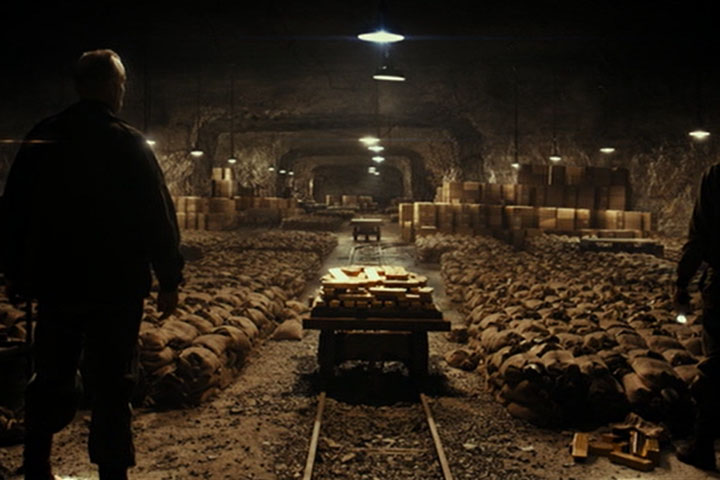
The truck driver of C-Company was busy transporting food and supplies to the liberated forced labor camps.  Those forced laborers were taken to rail stations to be returned to their homelands.  Most did not know if their homes and families survived the war years. Many would find they would be greeted at traitors when they got back to their home country.

As Allied troops, including the 75th Infantry Division, closed in the SS forced thousands of concentration camp prisoners on “evacuation” marches to prevent their liberation, resulting in mass deaths from hunger, exhaustion, and shooting. Despite the war being clearly lost, Nazi officials continued to demand high-speed production of war materials, with prisoners working in subterranean tunnels, factories, and on construction projects. The liberation of these camps was a slow, sometimes violent process. Many survivors were in critical condition, and thousands died even after liberation.

The 1st and 9th Armies split the Ruhr Industrial Pocket in half by April 14, 1945, specifically in the Hagen-Witten area, which is immediately west of Wetter on the Ruhr River. The organized resistance in this specific area collapsed around April 18, 1945, after the pocket was subdivided.