SECAC: Breaking Stereotypes: Recontextualizing Underrepresented Voices and Communities

The SECAC chair for Breaking Stereotypes: Recontextualizing Underrepresented Voices and Communities was Alexander Alvarez from the University of Central Florida. Alexander is an Orlando, Florida–based multidisciplinary artist and educator whose work blends iconography, mythology, and contemporary issues to explore memory, identity, and the human condition.

The first speaker was Jason Burrell who is an Assistant Director and Senior Lecturer at the University of Central Florida’s School of Visual Arts and Design, where he also serves as the Graduate Coordinator for Studio Art. His talk was titled, Office Supplies Disruptions: Rethinking Studio Art Practice Through Radical Material Accessibility. Jason is often rushing from meeting to meeting and began to sketch on post it notes which are readily available in any office setting. This easy access to materials lead to ongoing practice of using post it notes in his work. Jason had colorful post its on a side table during his talk, and encouraged the audience to take some. I decided to just place the post its on my sketch replacing what I had sketched on the screen.

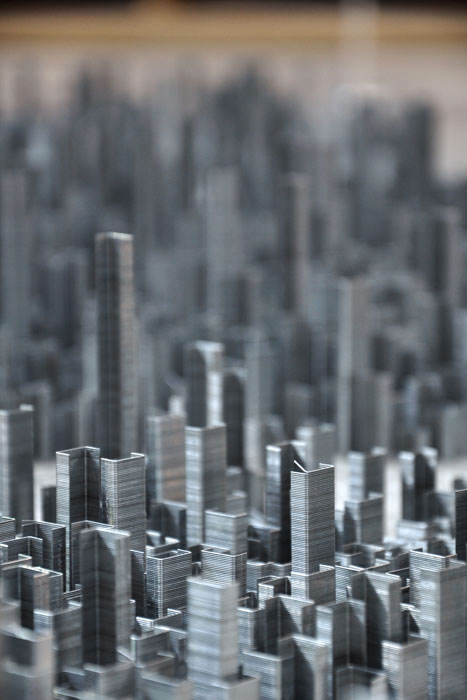
Jason pointed out that many beginning artists feel that becoming an artist is inaccessible since art supplies are so expensive. Jason makes that idea mute since he embraces supplies that are often available but overlooked. His presentation showed many artists who use office supplies in their work. One image showed an artist recreating a scale model of NYC on his hands and knees using nothing but staples to make skyscrapers. Another artist used push pins to make pointillist portraits. The wide variety of artists using found and repurposed office supplies was fascinating and made me want to rethink how art is made.

I immediately started thinking I should have my travel sketching students do thumbnail sketches on office post it notes. Stella Arbeláez Tascón also started thinking about using office supplies for a class project. Jason offered a straightforward presentation that flipped the expectations of what supplies should be used to make art. I have always thought that a pencil and a small slip of paper are all that is needed to document life with a sketch. Creative sparks come from the simplest of supplies.


SECAC: Life Disruptions as Opportunities for Artistic Growth, Session II

The SECAC Chair for Life Disruptions as Opportunities for Artistic Growth, Session II was Stella Arbeláez Tascón who earned her Masters degree in Studio Art from the University of Central Florida. I attended the first session the previous day and learned so much about how artists live through seismic life changes and use that change to fuel their art.

Steven Pearson from McDaniel College gave a talk titled, Pandemic Pivot: Teaching, Practice, and a Return to Representation. My own art had gone through a huge pivot during the worst of the COVID pandemic, so this talk was high on my list of sessions I needed to attend.

Steven’s early work representational with splashes of abstraction mixed in. Someone reviewing his work wondered when the artist would take the dive and work purely in abstraction. That comment lead Steve to venture into the world of abstraction.

Then the Pandemic hit and he found himself isolated in the studio. He read a book that said and artist should focus on their environment. He started doing detailed depictions of his studio and domestic life. He did a detailed sketch of an interior wall and then would go outside and do a view of the same wall from outside. Abstraction was abandoned as he worked to truly document his surroundings.

The representational work grew larger and he used historical allegories to depict domestic life when his family moved to the suburbs. He noticed a neighbor obsessively mowed his lawn several times a week and so he depicted himself in battle as a weekend warrior. One painting depicted him going up a staircase on a mission with a vacuum to clean his son’s room. He loved the humor in the allegorical painting but his son didn’t appreciate it.

Steve had a triptych of three very large painting in the SECAC Juried Exhibition.  All three depicted on scene of an above ground pool with a deck around it. In the first panel on the left the artist depicted himself blowing up an inner tube with a pile of inflated inner tubes beside him. The center panel depicted his daughter sitting on the deck with her legs out over the pool which was now covered. An inner tube which was inflated in the first panel came into this scene deflated. The right panel depicted his wife standing in a swimsuit straining leaves from the pool surface. This painting was done as the family was being pulled apart by divorce. The center panel felt lonely and desolate as the parents worked their separate chores far from each other.

Anna Vic Webb from the University of Central Florida gave a talk titled, Growing from Myself: Abstracting Self Portraiture as a New Framework of Visual Language for Abject Experiences and Ingrained Emotions. He talk was about what it is like to live with ADHD as an artist and how that framed her view of herself and the world. Many of her works are self portraits in a world that is distorted wit a fish eye perspective and vibrant colors. The eyes are often very expressive and piercing. In one she depicted herself seated on the floor holding her legs in a fetal position. Her concerned eyes were huge staring straight at the viewer. The hair on her legs became a vibrant expressive tangle. Creating with ADHD could feel fractured but it could also be a superpower as hyper focus leads to very productive periods of creation.

Having ADHD lead to periods of self-harm with chain smoking and putting herself in harmful situations. On painting showed her walking alone on a beach with blood red waves crashing on the shore. A full moon illuminated the scene and a shadow hinted that someone was about to block her way. There was a quiet menace to the scene.

What was most inspiring was how her art grew as she found new ways to live with and harness the power of having ADHD. The final piece that she showed was a huge departure from the other work. It still had vibrant colors, but the portrait was less warped and more polished. There are exciting possibilities as she continues to explore.

The final speaker was Kayla Lehman from Georgia Southern University, with her talk titled, Obsessive Compulsive Disruption: How OCD Has Impacted My Creative Practice. Kayla created a video game that depicted what it is like to get up pin the morning and find it impossible to get out the door while experiencing OCD.In the game the character went to the bathroom, and every task had to be obsessively scrutinized. The character would reach for a doorknob and then stop as multiple choices flashed up to once again wash hands or consider another task. Every task would have multiple choices about what should be done but ultimately there was no escape the character would never leave the room.

Her life impacted by OCD also lead to her creating a short CGI animated film. In the film people other than the lead character were depicted as having heads that were just an eyeball encased in black eye lids. The character had a dark cloud always on her shoulder which caused self doubt and an inability to find friends. Only when she realized that everyone else also had dark clouds did she begin to find friends. The clouds slowly became less opaque as she socialized.

The entire Life Disruptions as Opportunities for Artistic Growth session was so inspiring. All artists have their demons and need to find ways to silence doubts and create.

SECAC: Opening Reception

I drove to Winston Salem, North Carolina to attend a SECAC Conference with Stella Arbelaéz Tascón. SECAC stands for Southeastern College Art Conference. I was brought in as an illustrative journalist to cover the convention with sketches. Since I was offered a press pass, I felt I had to sketch every session I attended.

The drive to North Carolina was 10 hours, which was divided into two driving sessions. By the time we arrived at the Conference we were both exhausted. Stella’s world traveling mini poodle named Boo Boo came along for the Conference. Since we arrived late, there was no time to get him into a doggie day care. So, Stella brought him into the Conference in her shoulder bag. There is a hole in the shoulder bag which allows just Boo’s head to stick out. Most people never notice him or they think he is a plush stuffed animal.

The invitation said that the Opening Reception would happen in Salem 2, which was a large conference room. Outside that room there was plenty of small bites on tables, and each attendee got two drink tickets. Since I was waiting for the Salem 2 doors to open, I decided to get a plate of food and a white wine. I was feeling a bit tipsy from the single wine since I never drink. When I had finished the veggies, I had picked out for my dinner, I found that the Salem 2 Conference doors had still not opened. I opened one door and peaked inside to find a vast space filled with chairs. I decided to get a sweet slice of pie since I still had time to kill before I started my sketch.

When I finished my pie, I realized that the Salem 2 Conference room doors would never open. This informal gathering in the hallway was the event. I quickly whipped out my artist stool and sat down to sketch. Staff noticed me setting up and they complimented my on bringing along my own chair.

Then I dug into my art bag and pulled out my sketchbook. I had two sketchbooks to document the Conference. The small sketchbook I had used in the hotel room to write down the Conference Center address. I had then placed the sketchbook on my bed and forgot about it. At least I had the large hardbound sketchbook to work with. Then I realized I forgot my pen and pencil travel case. How on earth was I going to do a sketch, I didn’t have my art pencils, pens or watercolor brushes. Digging through my pockets I discovered I had a single yellow Ticonderoga pencil. I also had my watercolor palette but no brushes to apply the paint.

I had to put something on the page, so I started doing a very rough sketch with my pencil. Then I started applying watercolor with my finger and a rag. I wasn’t about to apply many colors I just needed to get something on the page.

While struggling with my sketch, I met Mina Rezghian. Mina is a University of South Carolina MFA candidate, She had three pieces on exhibit in the Annual SECAC Juried Exhibition. Thanks to exchanging Instagram information, I got to see some of her work. I briefly got to learn a little about her childhood in Iran. She mentioned a flood that washed away her collection of plush rabbits. My little sister had a plush rabbit that she held so often that it started to fall apart. She held the rabbit by its long partly detached ear and the rabbits butt dragged on the ground as my sister dragged it around. Mina’s childhood was washed away in a flash. Her father came to America feeling he could find a better life. Mina’s work reflects memories of a life that was tender and sweet and yet she came from a country that our President decided to bomb. On February 28, 2026 a U.S. Tomahawk missile struck an elementary school in Minab Iran, killing at least 156 people including 120 children and 26 teachers. After the brief conversation with Mina, I had a million more questions, but this is just an example of the amazing people that can be met at such an inspiring Conference.

In the Juried exhibition, Mina had two wooden pieces that had weathered photographs and that felt like antique momentous. A tiny photo of her cat walking in Mina’s grandmother’s courtyard was faded and yet evoked tender memories. The wooden panels were cut by Mina and she said the wood panels she had assembled stained and varnished held memories. I was lucky to meet this artist as I struggled with my sketch and at her opening at the juried group art show at Emerson Fine Arts Center at Salem College.


Shelter

While hiking with Stella Arbelaéz Tascón, we stopped at the Gravel Springs Hut which is a shelter on the Appalachian Trail in Shanandoah State Park in Virginia. While Stella was hiking the trail alone a week before, events transpired here which resulted in her decision to take time off from the hike and stay in a hostel. The story is hers to tell, so I will not relate it here. She shared her story on an Appalachian Trail Community Forum and the comments from many hikers were both supportive and vicious. That one tread said so much about the human condition.

We returned to the shelter late in the day to do a painting. Stella was taking the opportunity to paint locations on the trail that she had not painted before because she was focused on making sure she met her mileage goals. With me around she could slow her role since I am an inexperienced hiker. The final days of the hike became about finding the perfect painting locations and I was very comfortable with that.

We did stay in a shelter almost identical to this one. We ate our dinner on the picnic table and set up our sleeping bags inside the shelter which had a nice wooden floor. After the sun set, the wilderness came alive with a cacophony of sounds. A young married couple was also at this site but they were camping at a site a short distance away. They had both been married previously and had children. Their Brady Bunch family had a baby sitter so that the couple could spend quality time alone.

During the night I became convinced that I heard a bear wandering behind the shelter. I wanted to wake Stella up, but thought better of it. The sound soon shuffled off into the woods. I had a bear bag to store my food and toiletries. Scent proof bags were used to store food and the bear bag was in a steal locker which no bear would be able to open. Bears have to know that only inexperienced hikers would leave food unattended. I think this was my third day of hiking, so I was now an expert thru hiker.

Brooklyn’s Pizza

When I lived up in Lake County Florida I used to frequent Brooklyn’s Pizza (27405 US-27 Leesburg, Florida). When I went on a sketch outing with Stella Arbeláez Tascón to Brooklyn’s, we got to meet our server who was also an artist. She had just finished painting the restaurant front window with holiday themed art and it was darn good.

I went to Brooklyn’s Pizza sometimes for their delicious pizza but also for the occasional Alfredo and spaghetti meal. Besides the large plate of rich pasta there were also garlic knots which I could never finish. Brooklyn’s got my business on days where I didn’t have much available in the pantry and I didn’t feel like cooking. I felt comfortable eating on my own because the staff remembered me as that quirky artist who is always sketching. They were always curious to see what I would sketch next.

I can’t offer a biased review of the food at Brooklyn’s because I have just recently switched my diet to only plant-based foods. On my refrigerator is a note that says, “No Dairy, No Eggs, No Meat, No Oils, No Processed Foods”. I have started to read food labels to be sure I am not buying tons of hidden chemicals, salt and sugar. I now spent plenty of time searching for healthy foods which are a challenge to find in a Publix, with rows and rows of brightly colored junk food.

I am following an online course where I get to try out different recipes that are for delicious plant-based meals. Since I just moved onto my new Eola Heights Studio in a gorgeous old historic home, the timing is good, since I can stock my kitchen pantry with only whole plant-based food supplies.

The Alfredo spaghetti at Brooklyn’s Pizza was delicious but it has so much heavy cream which is no longer in my diet. The pizza which was also delicious is no longer something I would seek out when going out to eat. The cheese and white flour are both items that I am avoiding moving forward.

If you want a great pizza, Brooklyn’s is a great place to go. I think I will need to experiment to find a recipe for a great plant-based pizza. The cheese is the thing that will be most challenging to mimic. A healthy and savory tomato paste should be easy to make. I made my own spaghetti sauce for the first time last week. I know Cashew nuts and nutritional yeast have good cheese flavor. Most commercial baked goods have too much sugar and processed flour. As I learn more, I will find out which flours are nutritional and worth using. I have only dipped my toes in the water and taken my first baby steps towards a healthy plant-based diet. I will likely make mistakes along the way. But if I fall off the bike, I just need to get back on.

I didn’t purge my refrigerator and I had a large frozen pork loin left over. I made the pork loin several weeks ago and discovered that it is absolutely exhausting to digest meat once you have started a plant based diet. I actually had to stay in the studio that night and rest although I had plans to do a sketch at an event. I have shopped several times since that experience and no meat has made it back into the freezer.

Hand Art Center of Stetson University Deland Florida

Stella Arbeláez Tascón had been invited to exhibit at the Homer and Dolly Hand Art Center at Stetson University (139 E. Michigan Avenue DeLand, FL) for Looks Good On Paper: Second Edition in the Foyer and Gary R. Libby Gallery.

The public was invited to the exhibit featuring Fine Art Prints from the Central Florida Printmakers and Handmade Books from the Book Arts Guild of Central Florida.

Central Florida Printmakers included Stella Arbeláez, Marina Burgner, Meg Carroll, Katy Farmer, Jennifer Harper, David Hunter, Mindy Lighthipe, Bronwyn Merritt, Trent Mouton, Rhonda Peyton, Fontaine Rodgers, Mary Wentzel and Mori Olowu.

Book Arts Guild of Central Florida artists included Holly Jefferies, Meghan Medina, Rachel Simmons, Catherine Cross Tsintzos, Marie Patrick, Rachel Jerusha Kinbar, and Stephanie Rodriguez.

Stella attended the exhibit opening and I tagged along. Before exploring the whole show, I sat in the second gallery where there was a bench to get a quick sketch done. The artist who created the 2 by 4 installation piece was on hand along with his family. His wife was taking photos, and I managed to get his teenage daughter and son in my sketch. I think the kids knew I was sketching so they lingered as they looked at the art. The installation had a deflated mylar weather balloon, a tiny snail shell and some boxes with blinking diodes. Bricks were stacked inside the 2 by 4 supports. What it all meant I can not be sure but it felt extra-terrestrial. The artist was explaining to someone about how he hoards things in his studio certain that someday they will make it into an installation. He talked about obsessively poking holes in a fuel can, which must have been empty and sure enough the hole filled can was in the piece.

On the wall across from the installation was a series of small black and white prints by artist Oscar Bluemner who lived from 1867 to 1938. Oscar worked as an architect, initially in Germany and later in the United States, before turning to painting full time in 1911. One of the prints was of the little red lighthouse that was in Washington Heights below the George Washington Bridge. I have sketched the same lighthouse from my old neighborhood. I identified with his work because these small sketched felt like they were right out of his daily sketchbook. Oscars work is in the Whitney Museum of Art along as at Stetson University. I love discovering an artists work that I identify with.

There were some gorgeous prints in the next rooms. Stella shared her favorites as I explored the rooms for the first time. Also exciting were the handmade books by artists. The exhibit was so inspiring and was sponsored in part by the State of Florida through the Division of Arts and Culture and the National Endowment for the Arts.

The Looks Good On Paper Exhibit ran from January 20, 2026 to March 21, 2026.

Judith Segal Opening

Judith Segal is an advocate for all women artists in Central Florida. She had an opening in a group show in Mount Dora. The gallery was in the Mount Dora Center for the Arts in a former vintage mid-century service station (847 E. 5th Avenue, Mount Dora FL).

The exhibit by the Florida Sculptors Guild was called Hazards. Inside the gallery was packed. It felt too claustrophobic to get a sketch in there, so once I walked around and saw all the art, I went outside to do this sketch. In the rush to get to the gallery I had forgotten my hiking boots. I was wearing slippers to the show but didn’t notice until I got there with Stella Arbeláez Tascón. Bonnie Sprung shot a photo of me doing this sketch and sure enough, I was caught red handed wearing slippers to an art opening.

This chrome sculpture made from found parts was outside standing where a gas pump might have stood in the past. I took the artists card and wanted to sketch his studio space but I managed to loose the card. If anyone recognizes his work, please let me know. Judith’s art piece was smaller in size although it was a life sized shocking representation of a vagina. I am debating about whether it was cast from life. There was something flame like about the sculptural piece. For those who recognized what they were looking at, I bet it sparked conversation. Great art does that.

After the opening, Stella and I grabbed a bite to eat across the street. I got a text that a large number of artists were getting dinner at another restaurant in Mount Dora. When Stella and I were done eating we went over to meet the crowd who sat around a long table in the crowded restaurant.

In all it was a fun evening that made me realize that sculpture is very much alive in Central Florida.

Stella’s Print Party 2

Stella Arbeláez Tascón was working on a commission for the Orlando Museum of Art (OMA). She was responsible for creating beautiful tablecloths for a fundraiser dinner to be held at the museum.

The overall design of the dinner was loosely based on a 1979 Judy Chicago installation called The Dinner Party. The Dinner Party was built around a massive ceremonial banquet, arranged on a triangular table with a total of thirty-nine place settings, each commemorating an important woman from history.

To engage the public in the creative process, Stella held a Print Party where visitors to OMA could walk in and make a print on one of the tablecloths. I had already finished a sketch of the Print Party but realized I couldn’t see much of the tabletops from my seated angle, so I stood to do this second sketch. I loved watching people’s excitement as they added their personal touch to the art process.

There were about 4 or 5 volunteers who were recruited to help. Stella had to train everyone on the methods needed to make clean prints. The volunteers would then have to train each guest on how to make a print.

It was cute to watch children making what was probably the very first print they had ever made. I could see their eyes light up when they saw the results and many wanted to try and make another print. Adults exhibited just as much wonder.

Stella was very clear about making sure the ink rollers were stored face up and it was important that the guests rolled enough ink on the plates without putting too much ink down. Once a tablecloth had enough prints it was removed and put aside. Later all the finished tablecloths were moved to a classroom in the back of the museum.

Stella had purchased a simple, mechanical printing press. However, once on site, Stella preferred to use traditional hand printing methods instead, providing a more personal experience and control over the process for the guests. Flat wooden spatulas were used to burnish designs from the wood blocks with water-based inks onto the fabrics. As with Eco-Printing, there was a wide variety to the prints that were made at the print party. Some were light because the guest felt tentative, while others were bold and dark. Like all hand made art, the result reflected the spirit of the artist, even if it was their first time making a print.

In my humble opinion, the Paint Party was a smashing success.

Stella’s Print Party

Stella Arbeláez Tascón was working on a commission for the Orlando Museum of Art (OMA). She was creating tablecloths for a fundraiser dinner that would happen at the museum which was based on the 1979 installation by Judy Chicago called The Dinner Party.

Stella decided to use the commission to create Eco-prints on the tablecloths. This tied in nicely with her UCF Masters Thesis, which outlined the effects of communing with nature while thru hiking the Florida National Scenic Trail. That hike helped foster a lasting love of nature that inspires her work.

Prior to the Print Party, she Eco-printed many of the tablecloths. Eco-printing uses natural leaves to make prints directly on the fabric. Not all the Eco-prints were complete yet, but she also carved wood and foam blocks of leaves, birds and insects for guests to use.

The public was invited to a Print Party at OMA where they could help with making prints on the many fabric tablecloths. It is nerve wracking to have complete strangers contributing to such an intricate process. Multiple folding tables were set up in the gallery space right near the entry to the museum. The tablecloths were then laid flat on the table so guests could make prints.

Stella reached out to her old friend Leanne Klein for assistance during this event. Leanne is a good friend, recent transplant to FL and former classmate from her undergtad years at the Fashion Institute of Technology in New York. She holds an MFA from NYU and teaches printmaking workshops at the Tampa Museum. Leanne was a godsend because she interacted with the guests playfully and got them excited about making an artistic contribution.

The excitement built as more and more guests arrived.

Stella’s OMA Commission

I helped Stella Arbeláez Tascón, a fellow artist and friend, when she got a commission from the Orlando Museum of Art (OMA) to create tablecloths for a fundraiser event. Her idea was to eco-print leaves on the tablecloths along with woodblock prints. The fundraiser concept was built around the 1979 art installation by Judy Chicago called The Dinner Party. With that installation there were 39 elaborate place settings on a triangular table arrangement for 39 mythical and historical famous women. Including Kali, Sacajawea, Virginia Wolf, Susan B. Anthony and Georgia O’Keefe to name a few. The messaging goal of the Dinner Party was to end the ongoing cycle of omission in which women were written out of the historical record.
Stella had never eco-printed before, but she researched the process voraciously. After the fabric bolts were cut and hemmed, they were soaked in fresh water, dried, folded and stacked on a table set up outside. The next step was to boil water and soak the fabrics in chemicals that would allow the natural leaves to make impressions on the fabric. Since there were so many table clothes there were many boiling sessions.

I went with Stella when she purchased the old rusty butane stove for a song on Facebook Marketplace. When we picked it up there was a whole corrugated warehouse full of old abandoned equipment. A cow from the nearby field managed to get over the fence and had to be chased down to be put back in her field. That was all a sketch opportunity, but we were in and out rather fast to pick up the stove.

The water and fabrics frothed up in the huge metal pot and bubbled over the edge. When Stella finished stirring the pot, she went off to complete another task, and I sat and watched the pot while I sketched. I lowered the fuel nozzle a few times to keep the mix from boiling over. Once the boil was complete all the fabric was taken out and hung on outdoor clothes lines to dry in the breeze. Having this outdoor space to work on the project was critical since this was a messy process. The whole point of the eco-printing process was to celebrate the natural beauty of the outdoors.

In the background of this sketch is a hydroponics tower that was absolutely thriving. The edible lettuce was growing so fast that the tower was getting top heavy. The lettuce at the top was getting the most sunlight and it grew to the point that it broke the plastic tower in which the plant pots had been positioned. I patched the broken tower with plastic wrap because the water was leaking out of the tower and onto the ground. My fast, sloppy engineering fix seemed to work at least for the short term. I harvested the plants which were then drooping down unsupported and put them in bags in the refrigerator. The root system inside the tower was so huge that it would have to be cut out when all the plants were harvested. The greens lasted a long time in the refrigerator. I do believe some of them were eco-printed.