After sketching in Plettenburg Germany, I arranged to visit distant Thorspecken cousins in Wiesbaden Germany. Back in 1994 I visited all of the Thorspecken relatives I could find based on researching my family tree. One relative was a professional flute player for the state theater in Weisbaden. When I interviewed her back in 1994, she was nursing her newborn baby girl. That child was just married, and she helped me on this project by agreeing to allow me to ship the empty sketchbooks to her home in Koblinz Germany. When my first sketchbook was completely full, I drove to Koblinz to pick up the other 6 sketchbooks and was treated to a delicious traditional German breakfast in their home..
We all agreed to meet at Hessan State Theater in Wiesbaden. This is where my cousin performed fin the orchestra for so many years. She retired recently from performing in the theater, but she knows every nook and cranny of the place. One entrance of the theater was for the king and all his horses. She showed me the kings box seating which was of course the best seat in the house.
I loved when we explored the prop rooms and the huge scenic shop. Large scenic drops were on the floor being painted. Another theater had a rehearsal going on but my cousin marched in with confidence, and we watched for a while from the back rows. Another rehearsal was going on in a lobby which was super elegant with highly ornate gold trim. We watched that rehearsal which was in English from an upper balcony. The theater was a buzz with activity.
Wiesbaden is situated above natural hot springs. Steam can be seen rising from the ground in many spots. A fountain allowed people to sample the sulfur flavored water which is supposed to have healing properties.
My cousin used to live in Weisbaden but she just recently purchased a home out in the country. The home had a wood burning stove and a balcony that has a gorgeous view of the valley surrounded by large hills. I loved the way her home was decorated, it had an elegant old world feel. She practiced her English and I practiced my limited German. After a day of exploring Wiesbaden with my cousins, they insisted we go to a spot high on the mountain that overlooks the city to have a hot mulled wine. It was the perfect end cap to an amazing day.
 Wiesbaden became a military base during WWII for the General Command of the XII Army Corps and the 3rd battalion of the 38th Infantry Regiment. It was also a target for Allied bombings because of its industrial support for the Nazi war machine. Allied bombing raids targeted Wehrmacht facilities, the Glyco-Metalworks production plant, the Dyckerhoff and sons cement works, Kalle chemical works, the Albert chemical plant among others. There were frequent attacks on both industrial and residential areas. By the end of the war, around 30% of Wiesbaden’s buildings had been destroyed.
The Hessian State Theater that we visited, had extensive damage to the north side during the Allied air raid of February 2 to 3, 1945. In that air raid, nearly 500 British aircraft dropped 1,251 tons of bombs, including several so-called blockbuster bombs, which could destroy entire city blocks. But the city was lucky — heavy cloud cover meant it was spared the destruction suffered by many German cities in the war.
Wiesbaden was liberated from Nazi control on March 28, 1945, by the U.S. 80th Infantry Division alongside elements of the 4th Armored Division during the drive to the Rhine. On that morning at 5:45 a.m., a white flag was raised on the bunker at the museum, marking a peaceful surrender despite the Nero decree which insisted on evacuation and destruction of all infrastructure. My father, 1st lieutenant Arthur Thorspecken would have been much further north, crossing the Dortmund-Ems Canal on the way to attacking Dorsten Germay. The 75th Infantry Division did not take part in the liberation of Wiesbaden.
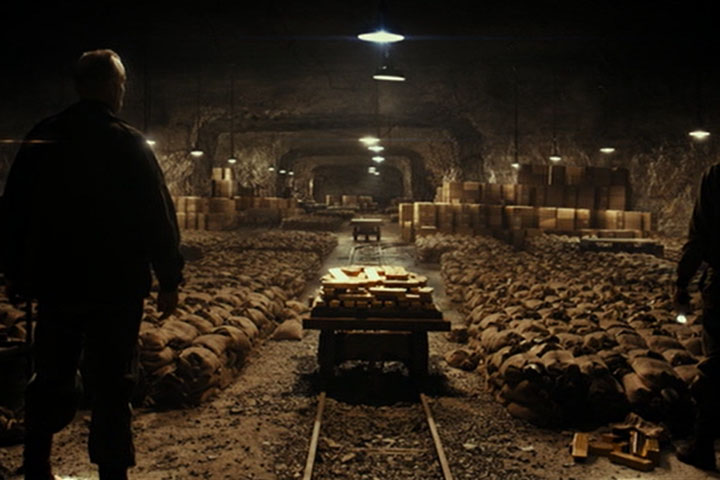
After Wiesbaden was liberated, it became a major hub for American forces. The city served as a major U.S. Air Force base (crucial during the 1948–49 Berlin Airlift) and housed the “Central Collecting Point” for art recovered from the Nazi’s by the Monuments Men.