50 Oldest Churches of NYC: New Utrecht Reformed Church

New Utrecht Reformed Church,  1827 83rd Street at 18th Avenue Bensonhurst, Brooklyn, New York is the fourth oldest Reformed Church in America.

The church was established in 1677 by ethnic Dutch residents in the town of New Utrecht, Brooklyn, several years after the English took over New Netherland (now Manhattan). Previously, the inhabitants of New Utrecht formed part of the congregations of Flatbush, Flatlands and Brooklyn.

The cemetery was consecrated in 1654 with 1300 dead interred there. The earliest recorded burial was in 1654. Members of such notable early Dutch settlers as the Van Pelts, Van Brunts, Cropseys, Cowenhovens and Bennetts are buried there.

During the Revolutionary War the British made New Utrecht their base of operations for the Battle of Long Island, the first large-scale British invasion of the colonies.

The Liberty Pole, the sixth on the site of the present church, was originally erected in 1783 at the end of the Revolutionary War to harass departing British troops. The Liberty Pole marks the spot over which the American flag first waved in the town of New Utrecht. The original pole was erected by our forefathers at the Evacuation of the British, November 1783, amid the firing of cannons and demonstration of joy.”

The present church was built in 1828 of stones taken from the original church, built in 1700. It is a rare example of a rural church in a picturesque setting in New York City. Construction was supervised by US Army engineer, Rene Edward De Russy, who led the construction of Fort Hamilton at New York harbor. The parish house was built in 1892 and the parsonage in 1906. This sketch is of the parish house.

The church was designated as a National Historic Landmark in 1966; the parish house and the cemetery received landmark status in 1998. Both the church and the cemetery are listed in the National Register of Historic Places.

50 Oldest Churches of NYC: Serbian Orthodox Cathedral of St. Sava

The church building was constructed in 1850-55 and was designed by architect Richard Upjohn in English Gothic Revival style. At the time it was known as Trinity Chapel which was one of several uptown chapels of the Trinity Church parish.

Celebrated American writer Edith Wharton (Jones) married socialite Edward Wharton in 1885 in Trinity Chapel; she was later to immortalize the church in her famous novel of Victorian New York, The Age of Innocence. Trinity Chapel was an active Episcopal Church community for a number of decades until 1915, when the area became commercial and parishioners began to relocate farther north.

The chapel was sold to the Serbian Eastern Orthodox parish in 1942, re-opening as the Cathedral of St. Sava in 1944. The entire church complex with furnishings was purchased in 1942 for $30,000. The Deed, signed on March 15, 1943, did not include a park on the southwest side of the church (present-day parking lot), speculated to have been sold at a later date.

Following the end of World War II, the Cathedral reached out to huge waves of refugees and immigrants from Yugoslavia. It was the only place where Serbs could meet, where they could preserve their faith and national identity, simultaneously a place to learn English and enter into their new, alien society and culture.

In the 1960’s, a powerful explosion from across 26th Street destroyed the original stained glass altar windows, which were subsequently replaced with stained glass windows in a Byzantine style motif. The Serbian Orthodox Cathedral of St. Sava was declared a national landmark building by the National Register of Historic Places, U.S. Department of the Interior, and the New York City Landmarks Preservation Commission. On April 18, 1968, the New York Landmarks Preservation Commission stated that the Cathedral’s “striking appearance commands special attention,” and that “its special character, historic significance, and aesthetic interest and value of the development, heritage, and cultural characteristics of New York make it irreplaceable”.

50 Oldest Church of NYC: John Street United Methodist Church

The John Street United Methodist Church, also known as Old John Street Methodist Episcopal Church, is located at 44 John Street between Nassau and William Streets in the Financial District of Manhattan, New York City. It was built in 1841 in the Georgian style, with the design attributed to William Hurry and or Philip Embury.

The story of the John Street Church actually begins in Ireland, where Philip Embury, his wife, Barbara Ruckle Heck (Embury’s cousin), and her husband were converted to Methodism. Philip Embury became one of Wesley’s local preachers. In 1760, a number of Irish Methodists, including the Emburys and the Hecks, immigrated to New York City.

The congregation is the oldest Methodist congregation in North America, founded on October 12, 1766 as the Wesleyan Society in America. The Society built its first church, a blue stucco barn called the Wesley Chapel, on this site in 1768; its design was attributed to Barbara Heck.

The second church on this site was built in 1817-18, and the extravagance of the building provoked a secession from the congregation by Rev. William Stillwell. The third church, the current one, was necessitated by the widening of John Street.

The church was designated a New York City Landmark in 1965 and added to the National Register of Historic Places in 1973.


50 Oldest Churches of NYC: Church of the Holy Apostles

The Church of the Holy Apostles is located at 296 Ninth Avenue at 28th Street in the Chelsea neighborhood of Manhattan, New York. Its historic church building was built from 1845 to 1848, and was designed by New York architect Minard Lafever. The geometric stained-glass windows were designed by William Jay Bolton.

The Holy Apostles congregation was founded in 1844 as the result of an outreach by Trinity Church to immigrants who worked on the Hudson River waterfront west of the Church’s location in the Chelsea section of Manhattan.

Lafever enlarged the building by 25 feet by adding a chancel in 1853–54. In 1858 the congregation needed to expand, so architect Charles Babcock of the firm of Richard Upjohn & Son enlarged the building into a cross-shaped sanctuary with the addition of transepts.

The church, is the only one that Lafever designed which remains standing in Manhattan. It is also one of the very few of Italianate design on the island.

It is rumored that the church was a stop on the Underground Railroad during the American Civil War.

In the 1970s, the church was instrumental in the foundation of Congregation Beit Simchat Torah, a synagogue for gays and lesbians begun by Jacob Gubbay. It hosted the congregation from 1973 to 1975, and again from December 1998 until it found a permanent home in April 2016.

In that same decade, Holy Apostles hosted the ordination of the first woman priest (and openly lesbian) in the New York diocese, Rev. Ellen Barrett.

In 1959, builders of Penn South, a housing cooperative that surrounded the church,  considered demolishing the church to make way for development.  Ultimately, four churches on the site, including the Church of the Holy Apostles, were saved. The sanctuary was badly damaged in 1990 by a fire, in which some of the stained-glass windows were lost. A restoration began almost immediately, and was completed in 1994 under the supervision of Ed Kamper, without interruption of the social services the church provides.

The Church of the Holy Apostles was designated a New York City landmark in 1966, and was added to the National Register of Historic Places in 1972.

50 Oldest Churches of NYC: Birlystoker Synagogue

The Bialystoker Synagogue is at 7–11 Bialystoker Place, formerly Willett Street, between Grand and Broome Streets in the Lower East Side neighborhood of Manhattan, New York City. It is an Orthodox Jewish synagogue.

The building with it’s Federal architecture was constructed in 1826 as the Willett Street Methodist Episcopal Church; the synagogue purchased the building in 1905.

The building is made of Manhattan schist from a quarry on nearby Pitt Street. As the synagogue is home to an Orthodox Jewish congregation, a balcony section was constructed to accommodate female congregants. In the corner of the women’s gallery there is a small hidden door in the wall that leads to a ladder going up to an attic, which is illuminated by two windows. When it was first opened, the building was a rest stop for the Underground Railroad movement; runaway slaves found sanctuary in this attic.

The Bialystoker Synagogue was first organized in 1865 on Manhattan’s Lower East Side as the Chevra Anshei Chesed of Bialystok, founded by a group of Jews who came from the town of Białystok, at that time located in the Russian Empire, but now in Poland. The congregation was begun in a building on Hester Street, it later moved to Orchard Street, and ultimately to its present location 7–11 Bialystoker Place on the Lower East Side.

During the Great Depression a decision was made to beautify the main sanctuary, to provide a sense of hope and inspiration to the community.

The synagogue was designated a New York City Landmark in 1966. It is one of only four early-19th century fieldstone religious buildings surviving from the late Federal period in Lower Manhattan, and is the oldest building used as a synagogue in New York City. It was added to National Register of Historic Places on April 26, 1972

50 Oldest Churches of NYC: Voorlezer’s House

Voorlezer is a Dutch word that can be translated as “fore-reader” or as “one who reads (to others)”. A Voorlezer or Voorleser was the title given to a highly responsible citizen in New Netherland and later Dutch settlements in North America, who had semi-official duties in local law, education and religion. The title was predominantly used from the mid-17th century to the late 18th century in the small colonial villages. A Voorlezer could be an assistant to a pastor or, in the absence of a pastor, hold religious services and read scriptures, or run a school.

The Voorlezer’s House on Arthur Kill Rd, Center Street, Staten Island, N.Y., is a historic clapboard frame house in Historic Richmond Town in Staten Island, New York. It is widely believed to be the oldest known schoolhouse in America, although the sole inhabitant to hold the title of voorlezer, Hendrick Kroesen, only lived on the property from 1696 until 1701.

The present structure became a private residence for more than a century and is now owned and operated by the Staten Island Historical Society. It is likely to have been constructed in the mid-eighteenth century, probably in the 1760s by Jacob Rezeau, whose family came into possession of the property in 1705.

In 1697, the Dutch Reformed Congregation acquired a parcel of approximately 271 square feet of the then 80 acre parcel of land from James Hance Dye and James Fitchett, on which to build the house. While never officially consecrated as a place of worship, a now-lost structure near the Voorlezer’s House (possibly the original schoolhouse) was used as a meeting place for members of the Dutch Reformed Congregation.

The first floor contains a small room used as living quarters and a large room for church services. The second floor has a small bedchamber, and a large room that is believed to be the one used for the school. The extra set of floor beams indicate that the room was designed to accommodate a large number of persons. The floors in the house are of white pine boards, 14–16 inches wide.

Though well-maintained for many years, by 1936 the building had fallen into disrepair and was threatened with demolition. It was acquired by the museum in 1939 and then restored to how it was believed to have appeared around the turn of the eighteenth century. It was first opened to the public on April 14, 1942, and then again, after its second restoration, on June 27, 1985. It became a National Historic Landmark in 1961 and was added to National Register of Historic Places when that registry was created in 1966.

50 Oldest Churches of NYC: Saint James Parish Hall

Saint James Parish Hall, is also known as Saint James Church, Church of England in America, Mission Church at Newtowne, Saint James Protestant Episcopal Church  or Old Saint James Church to distinguish it from the Saint James Episcopal Church two blocks away. It is located at 86-02 Broadway in the Elmhurst neighborhood of Queens in New York City.

The Mission Church at Newtowne was founded in 1704 as a mission of a parish based in Jamaica, Queens. The parish built its Newtown structure in 1735–1736 and became separate in 1761.

The church survived through the American Revolutionary War, since the Rector, Joshua Bloomer, was allied with the Loyalists. It was also a place of worship for British officers and men during the Revolution. The building was also used by British troops to store ammunition.

Boxed pews nearest the minister were generally reserved for the most important members of the community, while indentured servants, apprentices, slaves, and Native Americans were seated in the upper level of the tower.

The congregation used the building until a new church was built nearby in 1848, whereupon the old structure became a parish building. The graveyard at the old church remained in use until 1851, when most corpses were disinterred and relocated to the new church. The city government attempted to take the church’s former cemetery in the 1930s for the construction of a playground, under the argument that it was legally a town cemetery. In 1963, the Post Office wanted to buy Old St. James to tear it down for a new post office. The church rejected their offer.

The church was extensively repaired and expanded several times in the 18th and 19th centuries, including a major expansion in 1883. The old church building was used as a parish hall and Sunday school until 1941 when a new parish hall was built behind the newer St. James Episcopal Church. Since then, it has been used by several community groups, and was restored in 2004.

Saint James Church is designed in the English Colonial style and consists of the original main section and a rear section built in 1883. The interior features extensive carving and other decorative woodwork features. It was listed on the National Register of Historic Places in 1999. The New York City Landmarks Preservation Commission designated the church as a city landmark in 2017. The commission stated that the church was historically significant as the second-oldest church still standing in New York City, behind the Old Quaker Meeting House in Flushing, as well as the oldest surviving Anglican building and Church of England mission church.

Frank Lloyd Wright

On March 6th, Terry and I drove to Lakeland Florida to meet Seattle sketcher Carleen Zimmerman and her husband Neil. They were vacationing in Florida and the plan was to meet for lunch and then go to Florida Southern College to sketch. Lunch was delicious. I had a lasagna roll that was quite unique. Unfortunately it had rained on the entire drive to Lakeland.

I got to flip through Carleen’s Florida sketchbook which was almost completely filled.  She had read my book on the flight to Florida and was applying principles I had written about. I was quite pleased to see a note on one sketch that said, “Thor suggests building the pose from the feet up.” Most of the sketches were of Florida water foul. Carleen and Neil are avid birders. Because of that they are friends with Terry’s sister Rachel in Seattle.

It was still sprinkling when we were done with lunch. Carleen and Neil called it a day and went back to their hotel. Terry and I pushed on to see the Frank Lloyd Wright architecture at Florida Southern College a few miles away. Terry had been on a guided tour there once with her friend Elaine. She didn’t like the tour however since the guide just talked for two hours in the gift shop.

The campus is perfect to explore on a rainy day. Florida Southern
College
(FSC) has the largest concentration
of Wright designed structures anywhere in the world with 10 buildings and two additional
structures on campus, and is in the National Register of Historic Places
.
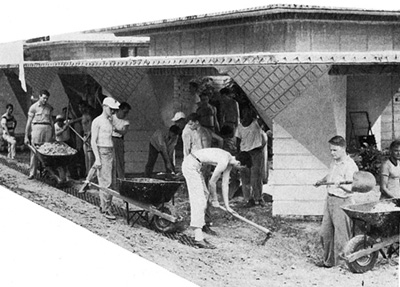
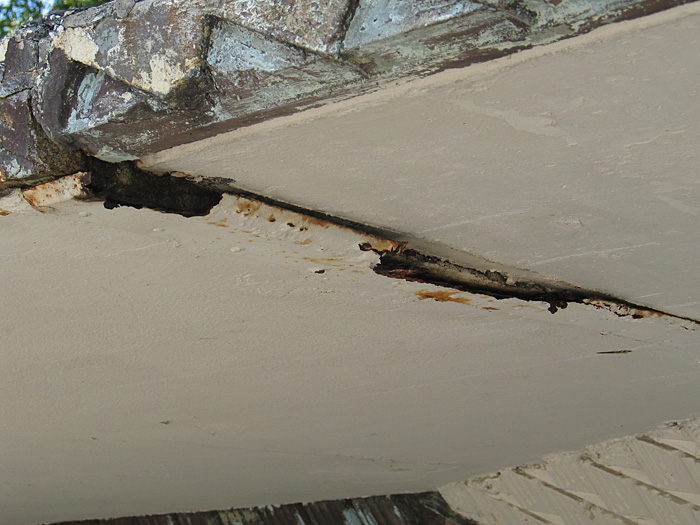
Construction on the campus began in 1938. Students helped with some of the construction. Wright designed an esplanade that cover all the pathways around the campus. What is unique about the overhangs is that they are only supported on one side leaving a completely unobstructed view on the open side.  If a walkway stepped down, so would the overhang. Wright must have been a short man. I began to feel claustrophobic, always feeling I might bump my head. The structures are also showing signs of wear and stress. Large cracks hint that the supports are having trouble bearing the load. Decorative custom brickwork had glass embedded into it, but students can’t resist digging out the glass like a gem from it’s matrix. Restoration work is needed everywhere.

A group of photographers explored the campus and I caught one in my sketch. An emergency phone looked like it had been bashed by a linebacker. It had one large red “Help” button for easy operation. I was shocked at how few students there were. There are 1800 undergraduate students but only one or two were seen by me on the campus walkways.