50 Oldest Churches of NYC: The Mariner’s Temple

The Mariner’s Temple Baptist Church located at 3 Henry Street, in the Two Bridges section of Manhattan, New York City, began as a mission for European seamen who docked at the nearby East River.

Built in 1795, the first church on the Henry and Oliver Street site was called the Oliver Street Meeting House. It was built due to to the generosity of landholder and philanthropist Henry Rutgers. Henry was the descendant of Dutch immigrants who settled in New York City in 1636 and he prospered as a brewer. Rutgers graduated from Kings College in 1766, was a colonel during the American Revolution, and later became politically active. He gave lands and funds to his own Dutch Reformed Church, to Presbyterian and Baptist churches, and to schools for children of the poor.

In 1843, the Oliver Street Meeting House burned down in a fire that left it in ashes. It was rebuilt over the next two years. The present Greek Revival building was inaugurated in 1845. Accounts differ on the lead architect behind the new church; 1844 church minutes indicate a little-known architect named Issac Lucas was behind the design, while the New York City Landmarks Preservation Commission attributes the design to the experienced and respected architect Minard Lafever, adding that Lucas was project superintendent.

The community that surrounded the church went through changes. By 1850, the densely populated Five Points neighborhood was notorious for crime, poverty, and disease. The church maintained a mission-driven presence in the community, focusing heavily on reaching out to troubled youths, reforming alcoholics, and trying to deter impoverished residents from a life of crime.

In 1859, a swanky, modern competitor called the Madison Avenue Baptist Church was built on Madison Avenue and 35th Street, it was described by the New York Sun as a “large and expensive church.” It cost $122,000 to build, or about $3.7 million today, and thus landed the church’s congregation in deep financial debt. Madison Avenue Baptist Church turned to the Oliver Street church for help, and its congregants agreed to give it. They contributed almost $80,000 towards their debt and agreed to merge with Madison Avenue Church. Mariners’ Temple purchased the Oliver Street building. The Sun reported that Oliver Street requested the deed to the other church’s property, to which Madison Avenue brought “a suit of ejectment against the Oliver street church folks.” A bitter court battle ensued. Judge Theodore Sedgwick eventually ended the church duel and ruled in favor of the Oliver Street Baptist Church. His decision prompted the full congregation’s return to their old home, now Mariners’ Temple on Oliver Street

Mariners’ stands on the oldest site for continuous Baptist worship in Manhattan.  It was designated a New York City Landmark on February 1, 1966. It was added to the U. S. Register of Historic places on April 16, 1980.

Stealth Omicron Special Operation

COVID-19 is re-grouping in the North East for a renewed campaign of it’s “Special Operation.” The so-called Stealth Omicron (BA.2) variant is now the dominant COVID-19 strain in the United States, according to data from the U.S. Centers for Disease Control and Prevention (CDC).

American however have let their guard down and turned their back on the enemy allowing for a full unchecked frontal attack.

A Trump appointed Federal Judge in Florida blocked the CDC’s masking guidelines on airlines. The CDC itself re-evaluated it’s guidance for the maps that shows where outbreaks are occurring. On top of that people are no longer using COVID testing sites instead relying on less accurate at home tests. Americans will simply not see this next wave coming. America has again decided to remain blind in fighting an enemy that can not be seen.

The Biden White House requested 22.5 Billion dollars to fight COVID-19 but that was cut down to 10 Billion allowing for no intentional aid. As long as the virus is anywhere in the world, it is everywhere in the world. This is a simple idea that legislators do not seem to understand. Of course all this aid will come too   late as the BA.2 variant begins it’s exponential growth in America in the coming weeks.

50 Oldest Churches of NYC: Saint Paul’s Church Yard

Built in 1766, Saint Paul’s Church  is the oldest surviving church building in Manhattan, and one of the nation’s finest examples of Late Georgian church architecture.

The main entrance to the church faced west toward the large churchyard and the Hudson River beyond what is now One World Trade Center.

Notable individuals buried in the church yard include, General Richard Montgomery, Revolutionary War hero ho is buried beneath the east porch of St. Paul’s.

John Bailey, who forged the George Washington battle sword in Fishkill, NY, while the Continental Army was encamped there. The sword is preserved in the Smithsonian Institution.

John Holt, a patriotic printer and editor of The New York Gazette, New York’s first newspaper founded by William Bradford, and The New York Journal.

George Frederick Cooke, a renowned British character actor. He played Richard III at the Park Lane Theatre to an audience of 2,000 on November 21, 1810.

George Eacker, a New York lawyer, who mortally wounded Alexander Hamilton’s son Philip in a duel. Alexander Hamilton is buried at Trinity Church in NYC.

In 1960, the chapel was named a National Historic Landmark; it was also made a New York City Landmark and placed on the National Register of Historic Places in 1966.

50 Oldest Churches of NYC: Trinity Churchyard Memorial

The Trinity Churchyard at 74 Trinity Place, near Wall Street and Broadway, includes tombstones and memorials dating back as far as 1681.  One of the largest monuments in the churchyard is the Soldiers’ Monument in honor of Revolutionary War soldiers held in captivity in the old Sugar House in New York City and thought to be buried at Trinity. The inscription said, “In memory of the officers and soldiers of the revolution ho died in British captivity in the city of New York, many of whom are buried in the North Part of Trinity Church yard  opposite Pine Street.

The claim those prisoners are buried in Trinity Churchyard is disputed by Charles I. Bushnell, who argued in 1863 that Trinity Church would not have accepted them because it supported Great Britain. The controversy was related to a proposal to build a public street through the churchyard.

Although his actual burial site is unknown, a bronze plaque commemorates Francis Lewis, a signer of the Declaration of Independence. He is the only signer buried in Manhattan.

The restored epitaph for the founder of New York’s first newspaper, William Bradford, is one of the most interesting in the churchyard: “Being quite worn out with Old age and labor he left this mortal State in the lively Hopes of a better Immortality. Reader reflect how soon you’ll quit the Stage…”

One of the churchyard’s most popular sites is Alexander Hamilton‘s tomb. In addition to being the namesake and main character of the Broadway hit Hamilton, he was the first Secretary of the Treasury, founded The Bank of New York and the U.S. Mint, and was the youngest framer of the Constitution. Elizabeth Schuyler Hamilton lies next to Alexander’s grave. Alexander Hamilton’s sister-in-law, Angelica Schuyler Church, is buried in the Livingston Family Vault. Her maternal grandmother was born a Livingston.


50 Oldest Churches of NYC: Saint Paul’s Church

Built in 1766, Saint Paul’s Chapel  is the oldest surviving church building in Manhattan. It is a chapel building of Trinity Church, an episcopal parish, built on land granted by Anne, Queen of Great Britain. Saint Paul’s is located at 209 Broadway, between Fulton Street and Vesey Street, in Lower Manhattan, New York City.

Built of Manhattan mica-schist, St. Paul’s has a classical portico, boxy proportions and domestic details that are characteristic of Georgian churches.  The church’s octagonal spire rises from a square base.

The church has historically been attributed to Thomas McBean, a Scottish architect. Recent documentation published by historian John Fitzhugh Millar suggests architect Peter Harrison may have instead been responsible for the structure’s design.

Upon completion in 1766, the church was the tallest building in New York City. It stood in a field some distance from the growing port city to the south and was built as a “chapel-of-ease” for parishioners who thought the mother church inconvenient to access.

The Hearts of Oak, militia unit organized early in the American Revolutionary War, was composed in part of King’s College students, who would drill in the Chapel’s yard before classes nearby. Alexander Hamilton was an officer of this unit. The chapel survived the Great New York City Fire of 1776 when a quarter of New York City (then confined to the lower tip of Manhattan), including Trinity Church, burned following the British capture of the city after the Battle of Long Island during the American Revolutionary War.

George Washington, along with members of the United States Congress, worshiped at St. Paul’s Chapel on his Inauguration Day, April 30, 1789. Washington also attended services at St. Paul’s during the two years New York City was the country’s capital. Above Washington’s pew is an 18th-century oil painting of the Great Seal of the United States, adopted in 1782.

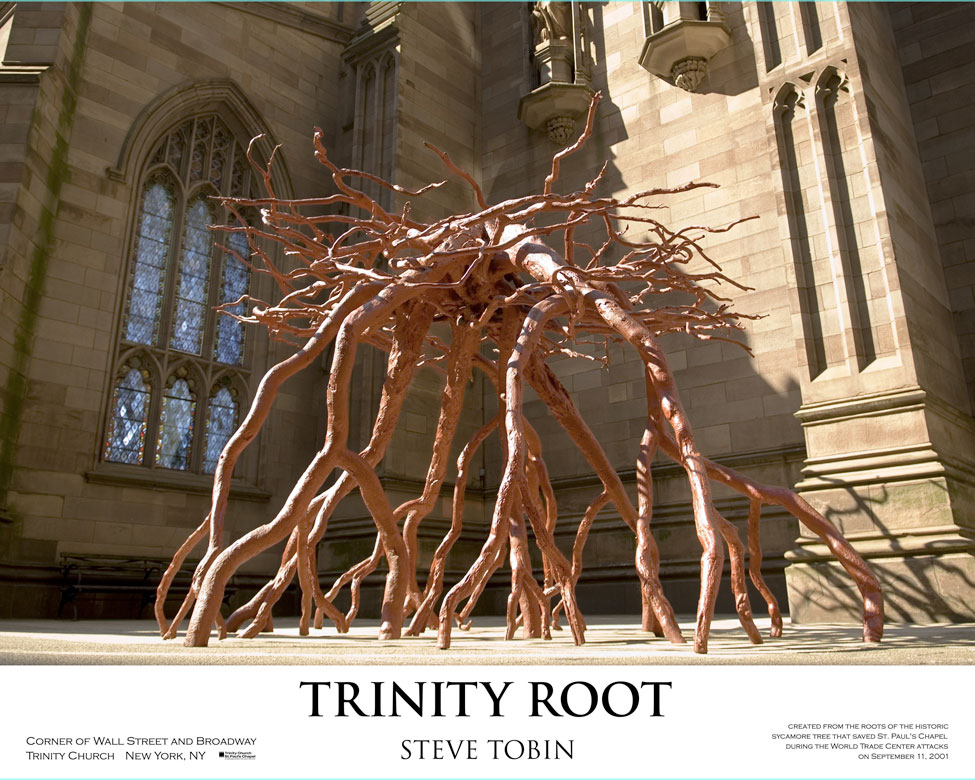
The rear of St. Paul’s Chapel faces Church Street, opposite the east side of the World Trade Center site. After the attacks on September 11, 2001, which led to the collapse of the twin towers of the World Trade Center, St. Paul’s Chapel served as a place of rest and refuge for recovery workers at the WTC site. For eight months, hundreds of volunteers worked 12-hour shifts around the clock, serving meals, making beds, counseling and praying with fire fighters, construction workers, police and others. Massage therapists, chiropractors, podiatrists and musicians also tended to their needs. The church survived without even a broken window. Church history declares it was spared by a miracle sycamore tree on the northwest corner of the property that was hit by falling debris. The tree’s root has been preserved in a bronze memorial by sculptor Steve Tobin.

In 1960, the chapel was named a National Historic Landmark; it was also made a New York City Landmark and placed on the National Register of Historic Places in 1966. When St. Paul’s Chapel remained standing after the September 11, 2001, attacks and the collapse of the World Trade Center behind it, the chapel was subsequently nicknamed “The Little Chapel That Stood”.

The Mosquito and the Elephant

Drones are rewriting the rules of war. Ukraine is fighting the might of Russia using tiny drones. They act as small mosquitos which sight and help target the lumbering elephant like tanks.

Drone operators were drawn from an air reconnaissance unit, Aerorozvidka, which began eight years ago as a group of volunteer IT specialists and hobbyists designing their own machines that have evolved into an essential element in Ukraine’s successful David-and-Goliath resistance.

A special IT force of 30 soldiers on quad bikes is vital part of Ukraine’s defense, but has to crowdfund for supplies. Lieutenant Colonal Yaroslav Honchar, gave an account of the ambush near the town of Ivankiv that helped stop the vast, lumbering Russian offensive in its tracks.

He said the Ukrainian fighters on quad bikes were able to approach the advancing Russian column at night by riding through the forest on either side of the road. The Ukrainian soldiers were equipped with night vision goggles, sniper rifles, remotely detonated mines, drones equipped with thermal imaging cameras and others capable of dropping small 1.5kg bombs. “This one little unit in the night destroyed two or three vehicles at the head of this convoy, and after that it was stuck. They stayed there two more nights, and [destroyed] many vehicles,” Honchar said.

Online there is a huge amount of aerial combat footage published by the Ukrainians which underlines the importance of drones to their resistance. “The tank was key at one point,” said John Parachini, a Rand Corporation military researcher. “Now drones may be the more decisive weapons system.” Ukrainians are using about 1,000 drones in the war effort, a military officer estimated. Many are mere “toys,” he said, “but we have what we have.”

“Those shiny tanks are being set ablaze – Bayraktar – that’s the new craze,” go the lyrics of a popular Ukrainian song dedicated to a drone that has become one of many symbols of the nation’s resistance. The drones “are part of the Ukrainian social media campaign that is executed very well by the Ukrainian military and civilians,” he said. Videos of Bayraktar strikes went viral on social media and that is “a great morale booster … a great tactical victory.”

Drones are also being used to target Russian tanks which are then targeted by Javelin anti-tank missiles.

50 Oldest Churches of NYC: Grace Church

Grace Church was initially organized in 1808 at Broadway and Rector Street, on the current site of the Empire State Building. Under rector Thomas House Taylor, who began service at the church in 1834, the decision was made to move the church uptown with the city’s expanding population. A site was chosen and property was purchased in what was then an apple orchard owned by Henry Brevoort, Jr. at Broadway between Tenth and Eleventh Streets.

James Renwick, Jr. who designed the new church building had no experience designing churches, instead instead he had a family background full of talent and influence, and family members on the church’s Vestry.

The rector, toured Europe extensively looking at church designs around the continent. He returned energized and adamant that the new church would be in the Gothic style. Renwick poured himself into the project and delivered. The new building was consecrated on March 7, 1846.

The windows were of the original building were of lightly tinted glass, not the majestic stained glass windows of today. The original steeple was made of wood, not marble; a marble steeple was eventually added in 1883. In 1879, Catharine Lorillard Wolfe donated funds for the building of the Chantry, a small chapel to be used as a Sunday School; she also provided the funds for the parish house situated between the Church and the Rectory. Her greatest gift was the Te Deum window, a soaring stained glass masterpiece that replaced the original East Window. It was her generosity that inspired other parishioners to follow; within ten years, 36 of the 46 stained glass windows were given.

50 Oldest Churches of NYC: Reformed Dutch Church of Newton

Reformed Dutch Church of Newton is a historic Reformed church in the Elmhurst neighborhood of Queens in New York City. The neighborhood had been established in 1652 by the Dutch as Middenburgh, a village suburb of New Amsterdam (today it is New York City).

In 1664, the village was renamed New Town, later simplified to Newtown. When Newtown was renamed Elmhurst in the late 1890s, the church retained its original name.

The church was first established by Dutch immigrants in 1731. The original Federal-Greek Revival style building, completed in 1735, had survived the struggles of the colonial days and the disruptions of the American Revolutionary War (during which the British seized it for use as an armory).

It was replaced in 1832 by the present Georgian-style sanctuary. It has been designated a New York City landmark. The cornerstone of the original building can still be seen in the foundation of its present structure. The bell tower contains the bell from the original 1731 church building. Adjoining the Church building to the north is a small cemetery filled with simple tombstones dating from the early years of the church’s history.

The sanctuary and adjoining fellowship hall are, as noted by the New York City Landmarks Preservation Commission, “one of the few all wood church groups remaining in the City.”The Reformed Church of Newtown Complex was added to the National Register of Historic Places in 1980. The originally Dutch church now had services in English, Taiwanese, Tamil and Mandarin Chinese.

Henry IV Part 2 at the Shakes

Pam and I went to a dress rehearsal for Henry IV Part 2. This is part of Orlando ShakesFire and Reign series, a seven Shakespeare production journey through history over three seasons covering the Rise of Henry V and the Wars of the Roses, from Richard IIRichard III.

“Uneasy lies the head that wears a crown.” William Shakespeare’s story of burnt bridges and growing pains stripped is down to a lively, raw, rambunctious performance, like nothing you’ve experienced before. Orlando Shakes’ actors will tackle Henry IV, Part 2 with less than 40 hours of rehearsal, no designers, and no director – just like the acting companies of Shakespeare’s time!

Actors blocked out the scenes themselves and selected their own costumes. Ned Averill Snell as the Gower wore a Rolling Stones T Shirt along with his medieval costuming. Philip Nolen as Falstaf chose to wear a bright red Santa suit. Brandon Roberts as Bardolph wore light blue sneakers.

Prior to the official start of the run Benjamin Bonenfant as Prince Hal and Lauren Culver ran through some lines. They jostled and joked and surprised each other as they hastily rehearsed the scene. Laughter in the scene mixed mixed with the laughter of their surprising each other as they performed. There is a real joy in this sort of anything goes attitude that made for a very fun production.

Masks are optional at the Shakes. Thankfully all staff seated in the audience wore masks as did we, but actors who are tested regularly performed without masks. When Henry IV stood hacking up a lung for minutes at a time center stage, the performance seemed too convincing during a pandemic. Overall it was a delightful and fun performance. This play is less about war and more about the father son relationship as the young prince moves away from deadbeat, carousing friends, like Falstaf who steer him wrong.

50 Oldest Churches of NYC: Friends Meeting House

The Flushing Friends Quaker Meeting House, also known as the Old Quaker Meeting House, is a historic Quaker house of worship located at 137-16 Northern Boulevard, in Flushing, Queens, New York.

It was designed by William Tubby, a prominent Brooklyn architect, to house the Brooklyn Friends School. Tubby was himself a Quaker and an early graduate of the school. The meeting house remains in regular use as a house of worship by the Brooklyn Meeting of the Religious Society of Friends.

Built in 1694 by John Bowne and other early Quakers, the Old Quaker Meeting House is, by all known accounts, the oldest house of worship in New York State and the second oldest Quaker meeting house in the nation. Visitors to the Meeting House have included George Washington, John Woolman and William Penn.

It is a plain rectangular building erected on a frame of forty-foot oak timbers, each hand hewn from a single tree. The architectural interest of the building is derived mainly from its unusually steep hipped roof; the roof is almost as high as the two stories below it. This feature can be traced to the high steep roofs of medieval Holland.

The Meeting House housed the first school in Flushing. For 300 years, Flushing Meeting members have made history struggling against religious intolerance, slavery, injustice and violence. And here Flushing Meeting continues to work, hope, and pray for a peaceful, just world.

It was declared a National Historic Landmark in 1967 and a New York City designated landmark in 1970.