50 Oldest Churches of NYC: Saint George’s Episcopal Church

St. George’s Episcopal Church is a historic church located at 209 East 16th Street at Rutherford Place, on Stuyvesant Square in Manhattan, New York City. It is considered “one of the first and most significant examples of Early Romanesque Revival church architecture in America”, the church exterior was designed by Charles Otto Blesch and the interior by Leopold Eidlitz. It is one of the two sanctuaries of the Calvary-St. George’s Parish.

The original St. George’s was a chapel built in 1752 by Trinity Church on Chapel Street (now Beekman Street) in Lower Manhattan.

In 1811 the congregation became independent, and in 1846–1856 they built this new church uptown, in fashionable Stuyvesant Square. One New Yorker described the location in his diary in 1848 “a howling wilderness.” The spires on each tower of the church were completed almost a decade after the remainder of the building. These masterful, lacy stone spires were deemed unsafe in 1888 and taken down in 1889.

The church was gutted by fire in 1865, everything in the in the interior was lost. The church was rebuilt within the next two years under the supervision of Leopold Eidlitz.

By 1880, the Episcopal church sat in the middle of a neighborhood filled with immigrants, who were largely Catholic and Jewish. The church decided to to downplay doctrinal matters, abolish pew rentals, and offer secular social services programs aimed at helping the poor, including an industrial school, sewing classes, soup kitchens, health programs, boys’ and girls’ clubs, and other educational and recreational initiatives.

In 1976, the parish merged with two others, Calvary Church, which was founded in 1832 and moved to the Gramercy Park area in 1842, and the Church of the Holy Communion, built on Sixth Avenue in 1844—to form the Calvary-St George’s Parish. Calvary Church is still operating, but the Church of the Holy Communion was deconsecrated and sold to pay down the debts of the new combined parish. It was adapted as the Limelight disco. It then operated as a marketplace and from 2017 as a gym.

Saint George’s was among the first of the new Landmarks Preservations Commissions designations, in 1967. The facade received a well-deserved restoration in 1980.

50 Oldest Church of NYC: John Street United Methodist Church

The John Street United Methodist Church, also known as Old John Street Methodist Episcopal Church, is located at 44 John Street between Nassau and William Streets in the Financial District of Manhattan, New York City. It was built in 1841 in the Georgian style, with the design attributed to William Hurry and or Philip Embury.

The story of the John Street Church actually begins in Ireland, where Philip Embury, his wife, Barbara Ruckle Heck (Embury’s cousin), and her husband were converted to Methodism. Philip Embury became one of Wesley’s local preachers. In 1760, a number of Irish Methodists, including the Emburys and the Hecks, immigrated to New York City.

The congregation is the oldest Methodist congregation in North America, founded on October 12, 1766 as the Wesleyan Society in America. The Society built its first church, a blue stucco barn called the Wesley Chapel, on this site in 1768; its design was attributed to Barbara Heck.

The second church on this site was built in 1817-18, and the extravagance of the building provoked a secession from the congregation by Rev. William Stillwell. The third church, the current one, was necessitated by the widening of John Street.

The church was designated a New York City Landmark in 1965 and added to the National Register of Historic Places in 1973.


50 Oldest Churches of NYC: Church of the Tranfiguration

The Church of the Transfiguration is a Roman Catholic parish located at 25 Mott Street on the northwest corner of Mosco Street in the Chinatown neighborhood of Manhattan, New York City.

The neighborhood around Mott Street in 1800 was had little to offer. The 48-acre Collect Pond, once a bucolic picnic spot was a dumping ground for the waste from nearby tanneries, breweries and slaughterhouses; creating in effect an open, rancid sewer. Despite this, a group of English Lutherans opted to build their new church in 1801 at a cost of $15.000 in the Georgian style of architecture for the “English Lutheran Church Zion.“.

On March 22, 1810, the Church was consecrated according to the rites and ceremonies of the Protestant Episcopal Church by the Reverend Benjamin Moore and renamed “Zion Protestant Episcopal Church.”

On August 31, 1815 a catastrophic fire swept through the area, destroying 35 homes and essentially gutting the church. The attempts to rebuild made by the rector, Reverend Ralph Willston, were so financially crippling that he was forced to resign in 1817 and the property was sold under foreclosure at public auction at the Tontine Coffee House on Wall Street.

Peter Lorillard purchased the building and reassured the concerned parishioners that he “would retain the property until some friends of the church would stipulate to finish rebuilding, and then restore it to its former ecclesiastical organization.” Six congregants stepped up with sizable donations, aided by a $10,000 loan from Trinity Church.

The renovated structure was completed in 1818, dedicated by Bishop Hobart on November 16.

The arrival of countless immigrant ships carrying Europe’s poor made the area around Zion Church a cesspool. Charles Dickens in 1841 thus described its horrors: “near the Tombs; Worth, Baxter, and Park Streets came together making five corners or points of varying sharpness, hence the name “Five Points.” It was an unwholesome district supplied with a few rickety buildings, and thickly populated with human beings of every age, color and condition.”

On January 28th, 1853, Zion Protestant Episcopal Church was sold to the Reverend John Hughes, of the Roman Catholic Diocese of New York. The church continued to serve the Irish, Italian and the Chinese immigrant populations in New York. It therefor became known as the “Church of Immigrants.”

In 1868, Henry Engelbert designed additions to the church, including the tower. In 1966, the building was designated by the New York City Landmarks Commission, who noted that it was one of four Georgian-Gothic landmark churches of locally quarried Manhattan schist on the Lower East Side.


50 Oldest Churches of NYC: Saint Paul’s Chapel

Saint Paul’s is a chapel building of Trinity Church, an episcopal parish, located at 209 Broadway, between Fulton Street and Vesey Street, in Lower Manhattan, New York City. Built in 1766, it is home to an active worshiping community.

Architects of the Chapel were  Andrew Gautier, James Crommelin Lawrence, and possibly Thomas McBean.

When it first opened in 1766 as an outreach chapel of Trinity Church to better serve its expanding congregation, St. Paul’s was a “chapel-of-ease” for those who did not want to walk a few blocks south along unpaved streets to Trinity. A decade later, the Great Fire of 1776 destroyed the first Trinity Church, but St. Paul’s survived, thanks to a bucket brigade dousing the building with water.

On April 30, 1789, after Washington took the oath of office to become the first President of the United States, he made his way from Federal Hall on Wall Street to St. Paul’s Chapel, where he attended services. He worshiped her often afterwards while NYC was the nation’s capitol.

On September 11, 2001, the World Trade Center buildings collapsed just across the street, yet there was no damage to St. Paul’s, earning it the nickname “the little chapel that stood.” St. Paul’s became the site of an extraordinary, round-the-clock relief ministry for the rescue and recovery workers that lasted nine months.

Tamid: The Downtown Synagogue has held services in St. Paul’s Chapel since 2012, and the chapel frequently hosts interfaith prayer events.

St. Paul’s Chapel, is the oldest public building in continuous use in New York City.

50 Oldest Churches of NYC: Old Saint Patrick’s Cathedral

The Basilica of Saint Patrick’s Old Cathedral, sometimes shortened to St. Patrick’s Old Cathedral or simply Old St. Patrick’s, is a Catholic parish church, basilica, and the former cathedral of the Archdiocese of New York, located on Milberry and Prince in the Nolita neighborhood of Lower Manhattan, New York City.

The cathedral was designed by the same architect who designed New York City Hall, Joseph Francois Mangin. When completed in 1815, it was the largest Catholic church in the United States.

On April 23, 1861 there was a blessing of the colors of the “Fighting” 69th “Irish Brigade” regiment by Archbishop Hughes before the regiment set off for active duty in the Civil War. My 2nd Great Grandfather John Hickey served in the 69th and fought in the battle of Bull Run, Antietam, Fredericksburg and .

A fire destroyed the interior of the Old Cathedral on October 6, 1866; it was rebuilt and re-opened on St. Patrick’s Day in 1868

On March 17, 1885, the debt of St. Patrick’s Old Cathedral was finally paid off, and the church was consecrated.

The Old Cathedral and associated buildings are among the first sites to be designated as New York City landmarks in1966. Campus complex was listed on the National Register of Historic Places in 1977.

50 Oldest Churches of NYC: Church of the Holy Apostles

The Church of the Holy Apostles is located at 296 Ninth Avenue at 28th Street in the Chelsea neighborhood of Manhattan, New York. Its historic church building was built from 1845 to 1848, and was designed by New York architect Minard Lafever. The geometric stained-glass windows were designed by William Jay Bolton.

The Holy Apostles congregation was founded in 1844 as the result of an outreach by Trinity Church to immigrants who worked on the Hudson River waterfront west of the Church’s location in the Chelsea section of Manhattan.

Lafever enlarged the building by 25 feet by adding a chancel in 1853–54. In 1858 the congregation needed to expand, so architect Charles Babcock of the firm of Richard Upjohn & Son enlarged the building into a cross-shaped sanctuary with the addition of transepts.

The church, is the only one that Lafever designed which remains standing in Manhattan. It is also one of the very few of Italianate design on the island.

It is rumored that the church was a stop on the Underground Railroad during the American Civil War.

In the 1970s, the church was instrumental in the foundation of Congregation Beit Simchat Torah, a synagogue for gays and lesbians begun by Jacob Gubbay. It hosted the congregation from 1973 to 1975, and again from December 1998 until it found a permanent home in April 2016.

In that same decade, Holy Apostles hosted the ordination of the first woman priest (and openly lesbian) in the New York diocese, Rev. Ellen Barrett.

In 1959, builders of Penn South, a housing cooperative that surrounded the church,  considered demolishing the church to make way for development.  Ultimately, four churches on the site, including the Church of the Holy Apostles, were saved. The sanctuary was badly damaged in 1990 by a fire, in which some of the stained-glass windows were lost. A restoration began almost immediately, and was completed in 1994 under the supervision of Ed Kamper, without interruption of the social services the church provides.

The Church of the Holy Apostles was designated a New York City landmark in 1966, and was added to the National Register of Historic Places in 1972.

Beauty and the Beast at the Garden Theater

Beauty and the Beast with music by Alan Menken, lyrics by Howard Ashman and Tim Rice, and book by Linda Woolverton is at the Garden Theater through May 22, 2022.

Trapped in her provincial life, an intelligent young woman risks everything to save her father from a terrifying Beast in an enchanted castle. Belle becomes the heroine of her own story as she discovers the power in daring to be different and breaks free from the expectations of her quiet village. Filled with dancing teapots, gorgeous costumes, and theatre magic, this international best-selling sensation has been re-imagined like never before for the Garden stage.

What I love about this production, which is produced in the Don’t Say Gay and Anti-Woke Bill state, is that the theatre selected a diverse cast, including Belle, a white role in the Disney movie, instead as powerful woman of color. The show also ignored conventional gender roles or identities, as well as infused African design motifs into the elegant costuming. The wardrobe in particular was fabulously dressed and knew how to belt out the tunes. The dusters in the castle wore tight red corseted costumes as they performed their Rockettes style kick dance routines. Chip managed to steal every scene he was in riding around the stage on a small tricycle. I am delighted the the show likely ruffled a few feathers in Winter Garden.

I sketched the show from the nose bleed section shoulder to shoulder with the tech crew. I was quite relived that all the theater staff wore masks and took every COVID precaution including  clear plastic shields in front of the tech equipment. From what I saw in the lobby, the audience was mostly unmasked and the show was close to being sold out. A fog machine demonstrated the movement of aerosol particles through the theater.

Another nice touch is that the Garden Theater will present an American Sign Language-interpreted performance and a Sensory Friendly performance for families that have members (both children and adults) with Sensory Processing Disorders (SPD), Autism Spectrum Disorders (ASD), and special needs.

50 Oldest Churches of NYC: Shrine of Saint Elizabeth Ann Bayley Seton

After the Civil War, Irish author Charlotte Grace O’Brien bought the James Watson House to be the Mission of Our Lady of the Rosary, which served as a way station for young immigrant girls. The parish was established in 1884 as a mission and raised to parish status in 1886 when Cardinal John McCloskey directed that Lower Manhattan and the Harbor Islands be separated from Saint Peter’s Parish and constitute the Parish of Our Lady of the Rosary.

The Shrine of St. Elizabeth Ann Bayley Seton is located in the Church of Our Lady of the Holy Rosary, a Roman Catholic parish church of the Roman Catholic Archdiocese of New York at 7 State Street, between Pearl and Water Streets in the Financial District of Manhattan, New York City.

Elizabeth Ann Seton lived at 8 State Street with her husband William Seton, after the bankruptcy of his business forced them to give up the Seton family home at 61 Stone Street. They stayed here from 1801 to 1803 before sailing to Italy for William’s health. In 1840 the site held the offices of a number of transportation companies, such as the New York and Hammondsport Lake Line Boats, the New York and Ithaca Line, and the New York and Seneca Falls Line Lake Boats. It also served as the “Eight South Street Hotel”.

Elizabeth Ann Seton was the first native-born citizen of the United States to be canonized by the Roman Catholic Church. She was received into the Roman Catholic faith at Saint Peter’s Church, Barclay Street in lower Manhattan, March 14, 1805. Elizabeth went to Maryland in 1808 and opened a school next to the chapel of St. Mary’s Seminary in Baltimore. Samuel Sutherland Cooper, a wealthy convert and seminarian, purchased 269 acres of land for an establishment for the sisterhood near Emmitsburg in the countryside of Frederick County, Maryland. According to tradition, Elizabeth named the area Saint Joseph’s Valley. In June 1809 she established the Sisters of Charity of St. Joseph. During the Civil War at least 270 sisters served as nurses and were called “angels of the battlefield” by both Union and Confederate soldiers.

The Georgian Revival, Colonial Revival brick church was built in 1964-5 at 22 Barclay Street, next to the Seton home, was designed by the firm of Shanley & Sturges.

50 Oldest Churches of NYC: Birlystoker Synagogue

The Bialystoker Synagogue is at 7–11 Bialystoker Place, formerly Willett Street, between Grand and Broome Streets in the Lower East Side neighborhood of Manhattan, New York City. It is an Orthodox Jewish synagogue.

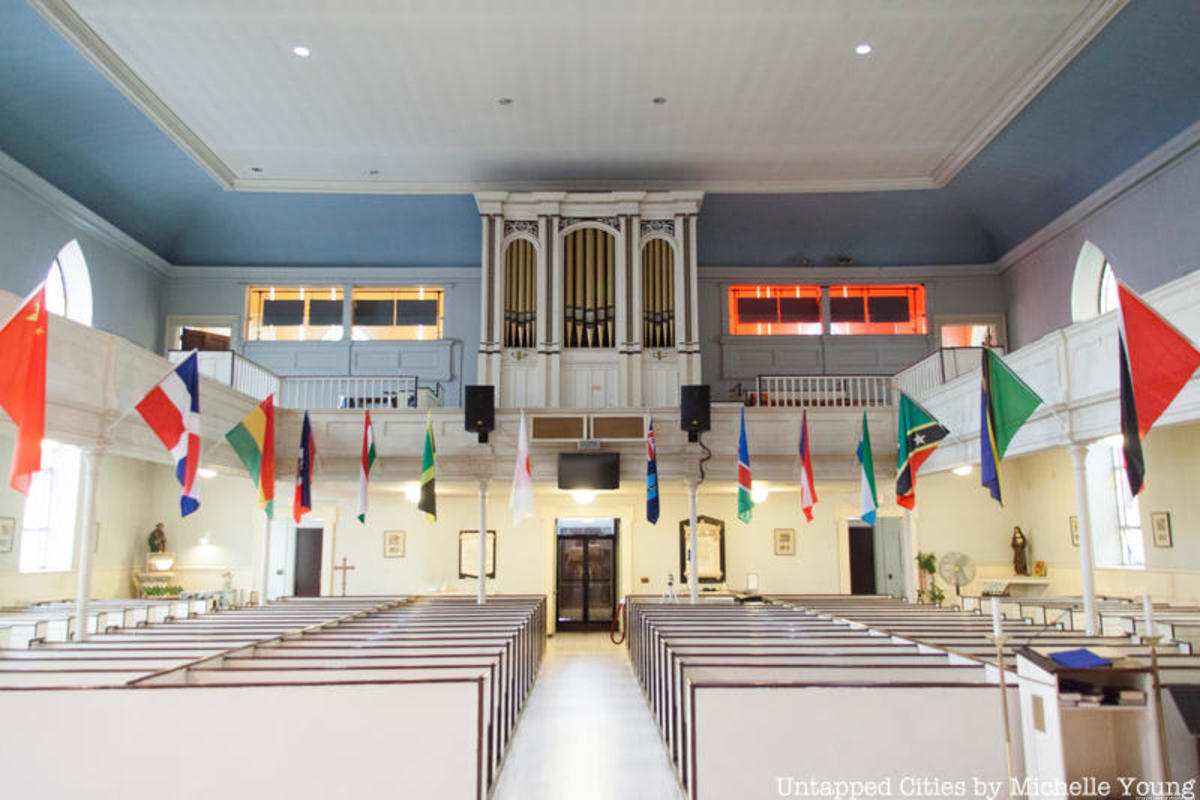
The building with it’s Federal architecture was constructed in 1826 as the Willett Street Methodist Episcopal Church; the synagogue purchased the building in 1905.

The building is made of Manhattan schist from a quarry on nearby Pitt Street. As the synagogue is home to an Orthodox Jewish congregation, a balcony section was constructed to accommodate female congregants. In the corner of the women’s gallery there is a small hidden door in the wall that leads to a ladder going up to an attic, which is illuminated by two windows. When it was first opened, the building was a rest stop for the Underground Railroad movement; runaway slaves found sanctuary in this attic.

The Bialystoker Synagogue was first organized in 1865 on Manhattan’s Lower East Side as the Chevra Anshei Chesed of Bialystok, founded by a group of Jews who came from the town of Białystok, at that time located in the Russian Empire, but now in Poland. The congregation was begun in a building on Hester Street, it later moved to Orchard Street, and ultimately to its present location 7–11 Bialystoker Place on the Lower East Side.

During the Great Depression a decision was made to beautify the main sanctuary, to provide a sense of hope and inspiration to the community.

The synagogue was designated a New York City Landmark in 1966. It is one of only four early-19th century fieldstone religious buildings surviving from the late Federal period in Lower Manhattan, and is the oldest building used as a synagogue in New York City. It was added to National Register of Historic Places on April 26, 1972

50 Oldest Churches of NYC: Saint Augustine’s Episcopal Church

Saint Augustine’s Episcopal Church is located at 290 Henry Street between Montgomery and Jackson Streets on the Lower East Side of Manhattan, New York City.

The church began in 1819 as a mission near the old Grand Street Ferry run by students of the General Theological Seminary. Led by former mayor, Marinus Willett, the mission grew. It was organized as a parish in 1824, and construction began on All Saints’ Free Church (“Free” meaning free of pew rent), around 1827. It was built of Manhattan schist. Around this time “Mount Pitt” (also known as Jones Hill), near Pitt and Grand Streets, was being leveled, and some of field stone used was taken from there.

The design, a Georgian structure with Gothic windows, is credited to John Heath. The church was consecrated in 1828 by Bishop John Henry Hobart. Edgar Allan Poe used to attend on occasion during the church’s early years.
St. Augustine’s is one of the few remaining churches in the country to retain its “slave galleries,” small, hidden rooms at the back of the church designed in the 1820’s as seating for enslaved African Americans. It was there that enslaved people were placed sit out of sight of the white congregation during church services.
The churches wooden steeple with slate tiles was lost some time after 1934. In 1949, the congregation merged with St. Augustine’s Chapel of Trinity Church, then located at 107 East Houston Street, and the new combined congregation used the building on Henry Street. The parish became independent of Trinity in 1976.
It was added to National Register of Historic Places on May 6, 1980.